Publications /
Book / Report

Back
Africa Economic Symposium (AES) 3nd edition - SUMMARY REPORT
Authors
General rapporteur Mahmoud Arbouch
September 2, 2025

The Africa Economic Symposium (AES) has firmly established itself as one of the flagship annual events of the Policy Center for the New South, alongside the Atlantic Dialogues and the African Peace and Security Annual Conference (APSACO). Now in its third edition, AES continues to provide a unique platform for economists, policymakers, and academics from across the continent and beyond to exchange perspectives on the pressing macroeconomic and structural challenges facing Africa. Its mission remains to foster rigorous, evidence-based debates that inform policymaking and support long-term strategies for Africa’s development in an era of uncertainty. 

The 2025 edition, convened under the theme “Bold Moves amid Global Shifts,” explored the difficult policy trade-offs confronting African governments as they navigate a volatile global environment. The continent’s recovery from COVID-19 has been uneven, while debt pressures, supply chain disruptions, and geopolitical tensions weigh heavily on fiscal and economic resilience. Structural challenges such as persistent unemployment, low productivity, and the exclusion of Africa’s youth continue to hinder inclusive growth, even as policymakers are called upon to adapt to deep systemic uncertainty. 

The symposium underscored that many African states are increasingly resorting to short-term stabilization measures—such as accumulating reserves and postponing reforms—that may provide immediate security but risk delaying the structural transformation urgently needed. Against this backdrop, AES 2025 called for a careful balance between fiscal prudence, social investment, and the pursuit of sustainable growth, placing emphasis on reforming governance, improving macroeconomic management, and accelerating structural change. 

The discussions highlighted the urgent need to rethink Africa’s economic strategies in a shifting global order. From debt sustainability and the role of central banks to the promise of financial innovation, digital inclusion, and new instruments such as central bank digital currencies, the symposium emphasized that policy choices must align with long-term transformation goals. The debates also explored the opportunities and challenges of regional integration, trade connectivity, and development finance, all of which are essential levers for Africa’s resilience and prosperity. 

As in previous editions, the Annual Report on African Economies was launched alongside the symposium, offering an in-depth analysis of the continent’s macroeconomic dynamics and structural transformation pathways. More than just a publication, the report reflects the collective intellectual effort of leading scholars and practitioners, providing evidence-based insights to guide decision- makers. Together, the symposium and the report reinforced the Policy Center for the New South’s commitment to fostering forward-looking economic thinking that moves beyond short-term headlines to tackle Africa’s enduring challenges.

RELATED CONTENT

  • Authors
    April 25, 2024
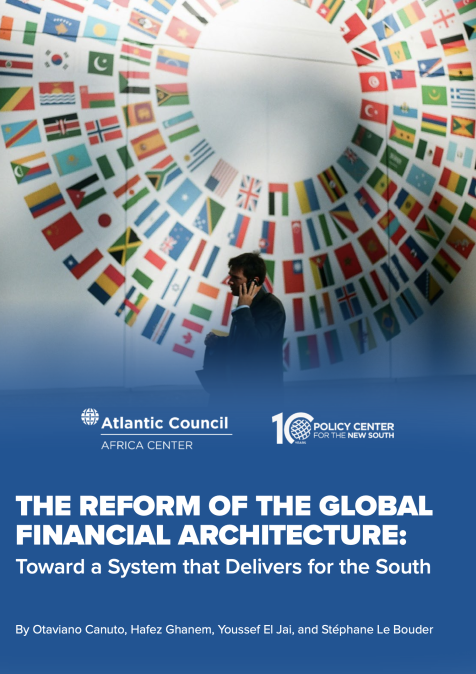
    The Policy Center for the New South and the Atlantic Council Africa Center have jointly released a report on “The Reform of the Global Financial Architecture: Toward a System that Delivers for the South,” by Otaviano Canuto, Hafez Ghanem, Youssef El Jai, and Stéphane Le Bouder. This report issues specific and urgent calls for reform, including more representative global governance, increasing the World Bank’s operational and financial capacity, prioritizing programs that would inte ...
  • April 23, 2024
    نخصص حلقة الأسبوع من برنامج "حديث الثلاثاء" لموضوع تأنيث الهجرة في المغرب، من خلال دراسة وضع النساء المغربيات العاملات في مجال الفلاحة. استنادا إلى بحث ميداني أُجري في جهة سوس ماسة لاستقصاء الديناميات والتحديات التي تعترض هذه الفئة، مقارنة بوضع نظيراتهن المغربيات العاملات في القطاع ذاته...
  • Authors
    April 22, 2024
    Developing countries that identify themselves as parts of the Global South (GS) face a difficult task in making their collective influence felt in international affairs. They can achieve this goal only if they succeed in developing institutions to coordinate their policies efficiently around agreed agendas, in order to be in a position to negotiate more effectively with developed countries to reform the current international political and economic system. As a template they should l ...
  • April 18, 2024
    The writing of this Report started in november 2023 and benefited during six months from the quality of discussions in the Policy center. Paul Isbel, Professor at UM6P, was a relentless proofreader who generously brought his outstanding competence in economy and political economy. Stephen Gardner went beyond his role as linguistic proofreader and showed an admirable understanding of the substance at stake. Under the direct supervision of Professor Abdelaziz Aitali, the Economic Depa ...
  • April 18, 2024
    L'émergence fulgurante de l'intelligence artificielle (IA) représente un phénomène mondial, marqué par une croissance exponentielle des publications et des investissements massifs atteignant 189,6 milliards USD en 2021, contre environ 14,7 milliards en 2013. Cette accélération suscite une prise de conscience accrue de la nécessité pressante de mettre en place une gouvernance efficace de l'IA, comme en témoigne l'augmentation significative du nombre de projets de loi dédiés, passant ...
  • April 18, 2024
    Dans cet épisode, nous accueillons M. Badr Mandri, Economiste au Policy Center for the New South qui partage son analyse sur « La Dette et développement en Afrique ». Plusieurs pays d'Afrique ont déclaré un défaut de paiement ou se sont engagés dans des initiatives de suspension du serv...
  • Authors
    April 17, 2024
    The Internaional Monetary Fund World Economic Outlook, issued on April 16, projected China’s economic growth rate at 4.6% and 4.1% for, respectively, 2024 and 2025. In 2023, after China’s economic reopening with the end of the ‘zero-COVID’ policy, the rate was 5.2%, above the official target of 5% (Figure 1). For 2024, the official target has been set at 5% again. Notwithstanding the challenges we discuss here, China’s macroeconomic performance in the first quarter of 2024 has been ...
  • Authors
    April 15, 2024
    Prior to her visit to China on April 4—her second in nine months—Janet Yellen, United States Secretary of the Treasury, sent a message demanding that the country should not flood the world with cheap exports of clean energy. This would “distort global markets and harm workers abroad,” she said. According to a senior U.S. Treasury official, China’s excess industrial capacity and the government support that has fueled it were subject of discussion during her meeting with Chinese Premi ...