Publications /
Book / Report

Back
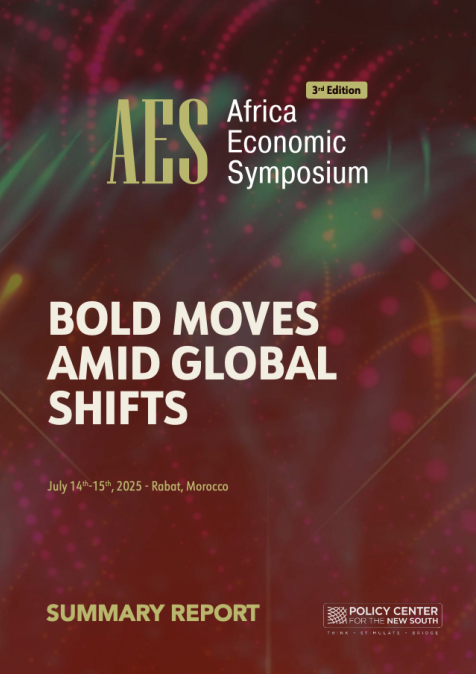
Africa Economic Symposium (AES) 3nd edition - SUMMARY REPORT
Authors
General rapporteur Mahmoud Arbouch
September 2, 2025

The Africa Economic Symposium (AES) has firmly established itself as one of the flagship annual events of the Policy Center for the New South, alongside the Atlantic Dialogues and the African Peace and Security Annual Conference (APSACO). Now in its third edition, AES continues to provide a unique platform for economists, policymakers, and academics from across the continent and beyond to exchange perspectives on the pressing macroeconomic and structural challenges facing Africa. Its mission remains to foster rigorous, evidence-based debates that inform policymaking and support long-term strategies for Africa’s development in an era of uncertainty. 

The 2025 edition, convened under the theme “Bold Moves amid Global Shifts,” explored the difficult policy trade-offs confronting African governments as they navigate a volatile global environment. The continent’s recovery from COVID-19 has been uneven, while debt pressures, supply chain disruptions, and geopolitical tensions weigh heavily on fiscal and economic resilience. Structural challenges such as persistent unemployment, low productivity, and the exclusion of Africa’s youth continue to hinder inclusive growth, even as policymakers are called upon to adapt to deep systemic uncertainty. 

The symposium underscored that many African states are increasingly resorting to short-term stabilization measures—such as accumulating reserves and postponing reforms—that may provide immediate security but risk delaying the structural transformation urgently needed. Against this backdrop, AES 2025 called for a careful balance between fiscal prudence, social investment, and the pursuit of sustainable growth, placing emphasis on reforming governance, improving macroeconomic management, and accelerating structural change. 

The discussions highlighted the urgent need to rethink Africa’s economic strategies in a shifting global order. From debt sustainability and the role of central banks to the promise of financial innovation, digital inclusion, and new instruments such as central bank digital currencies, the symposium emphasized that policy choices must align with long-term transformation goals. The debates also explored the opportunities and challenges of regional integration, trade connectivity, and development finance, all of which are essential levers for Africa’s resilience and prosperity. 

As in previous editions, the Annual Report on African Economies was launched alongside the symposium, offering an in-depth analysis of the continent’s macroeconomic dynamics and structural transformation pathways. More than just a publication, the report reflects the collective intellectual effort of leading scholars and practitioners, providing evidence-based insights to guide decision- makers. Together, the symposium and the report reinforced the Policy Center for the New South’s commitment to fostering forward-looking economic thinking that moves beyond short-term headlines to tackle Africa’s enduring challenges.

RELATED CONTENT

  • November 5, 2019
    In this brief, we review the evidence on Morocco’s export concentration, discuss its causes, and then draw some policy implications. The main message is that Morocco needs to raise its game in some less familiar markets and move outside its comfort zone. This implies not only investments by private firms, greater efforts on export promotion by the government and professional associations, but also deeper changes within Morocco, including in its educational system. Over the past two ...
  • Authors
    November 5, 2019
    Since 2013, armed conflict has raged in the Central African Republic, between the largely Muslim Seleka rebels and the predominantly Christian militias (known as the anti-Balaka). Rebel groups are controlling broad swathes of the country, exploiting mineral wealth, and levying taxes on cattle migration. Non-state actors such as the Popular Front for the Governance of the Central African Republic (FPRC), which claims to “govern” the country’s northeast, have severely tested the autho ...
  • Authors
    Morten Seja
    November 1, 2019
    The author is an alumnus of the Atlantic Dialogues Emeging Leaders Program 2014. The discussion on industry 4.0 (also often referred to as smart manufacturing or industrial internet of things – which is the term mostly used in the United States of America) has graduated from being a niche topic discussed (and implemented) by engineers in the world’s richest economies. If industry 4.0 has not physically arrived everywhere, it is at least in the minds of some: industry 4.0 in&nb ...
  • Authors
    Samuel Arnaud
    October 28, 2019
    Africa, as a continent of economic opportunities, is attracting foreign players. In this context, India is emerging as an important partner, especially for Eastern and Southern Africa. The complexity of its geopolitical environment combined with internal specificities motivated the revival of interest for the continent. This paper draws on historical developments between India and African countries to provide the state of play of recent linkages. Those trends are better perceived th ...
  • Authors
    October 28, 2019
    Global GDP has slowed sharply, from near 4% in late 2017 to half that rate on an annualized basis in recent quarters. The downturn in fortunes over the last two years has come as a big surprise. The rapid expansion of 2016/2017 was broad based but died young. Prior to it we had suffered seven long years of slow growth in the wake of the global financial crisis Why did such a sharp and steady slowdown occur against a background of loose monetary policy, supportive fiscal policy, low ...
  • Authors
    Paula Tavares
    October 25, 2019
    As world leaders gathered this month for high-level talks at the 74th United Nations General Assembly, pressing global issues were at the forefront of discussions, including progress toward the 2030 Agenda and the Sustainable Development Goals (SDGs). While taking stock of how far we have come in realizing commitments in key areas, including to end poverty and hunger, expand access to health, education, justice and jobs, promote inclusive and sustained economic growth, and protect o ...
  • Authors
    Sabine Cessou
    October 25, 2019
    Eric Ntumba, a young Congolese banker, came from Kinshasa in December 2017 to participate in the Atlantic Dialogues Emerging Leaders Programme of the Policy Center for the New South (PCNS) in Marrakech. At that time, when asked what his dream was, he immediately said he would like : « to become President of the Democratic Republic of Congo (DRC) and bring about inclusive development, so that the country’s enormous potential can be finally transformed into power. My dream i ...
  • Authors
    Sabine Cessou
    October 25, 2019
    Jeune banquier congolais, Eric Ntumba est venu de Kinshasa en décembre 2017 pour participer au programme Atlantic Dialogues Emerging Leaders du Policy Center for the New South (PCNS) à Marrakech. À l’époque, lorsqu’on lui demandait quel était son rêve, il déclarait d’emblée : « Devenir président de la République démocratique du Congo (RDC) et apporter un développement inclusif, pour faire que le potentiel énorme de ce pays se transforme enfin en puissance. Mon rêve es ...
  • October 14, 2019
    The objective of this paper is to better understand the evolution of manufacturing employment across the world. Manufacturing value added has grown rapidly since 2000, at least matching world GDP growth, even after the global financial crisis, reflecting mainly rising demand for manufactures especially in developing countries. However, manufacturing employment increased at only a slow pace, both before and after the global financial crisis. Manufacturing employment growth provided o ...