Publications /
Book / Report

Back
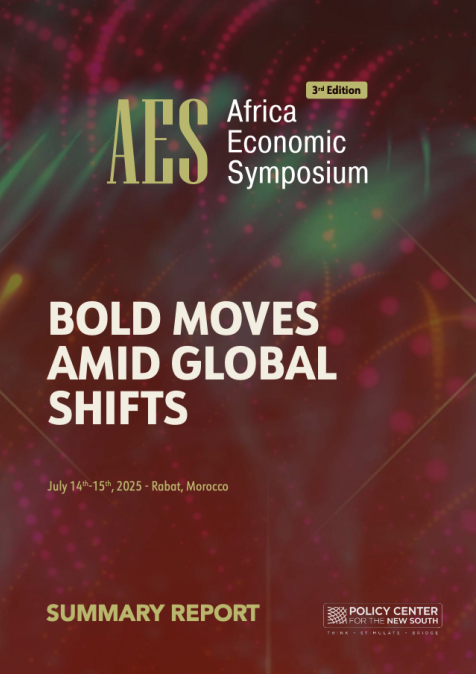
Africa Economic Symposium (AES) 3nd edition - SUMMARY REPORT
Authors
General rapporteur Mahmoud Arbouch
September 2, 2025

The Africa Economic Symposium (AES) has firmly established itself as one of the flagship annual events of the Policy Center for the New South, alongside the Atlantic Dialogues and the African Peace and Security Annual Conference (APSACO). Now in its third edition, AES continues to provide a unique platform for economists, policymakers, and academics from across the continent and beyond to exchange perspectives on the pressing macroeconomic and structural challenges facing Africa. Its mission remains to foster rigorous, evidence-based debates that inform policymaking and support long-term strategies for Africa’s development in an era of uncertainty. 

The 2025 edition, convened under the theme “Bold Moves amid Global Shifts,” explored the difficult policy trade-offs confronting African governments as they navigate a volatile global environment. The continent’s recovery from COVID-19 has been uneven, while debt pressures, supply chain disruptions, and geopolitical tensions weigh heavily on fiscal and economic resilience. Structural challenges such as persistent unemployment, low productivity, and the exclusion of Africa’s youth continue to hinder inclusive growth, even as policymakers are called upon to adapt to deep systemic uncertainty. 

The symposium underscored that many African states are increasingly resorting to short-term stabilization measures—such as accumulating reserves and postponing reforms—that may provide immediate security but risk delaying the structural transformation urgently needed. Against this backdrop, AES 2025 called for a careful balance between fiscal prudence, social investment, and the pursuit of sustainable growth, placing emphasis on reforming governance, improving macroeconomic management, and accelerating structural change. 

The discussions highlighted the urgent need to rethink Africa’s economic strategies in a shifting global order. From debt sustainability and the role of central banks to the promise of financial innovation, digital inclusion, and new instruments such as central bank digital currencies, the symposium emphasized that policy choices must align with long-term transformation goals. The debates also explored the opportunities and challenges of regional integration, trade connectivity, and development finance, all of which are essential levers for Africa’s resilience and prosperity. 

As in previous editions, the Annual Report on African Economies was launched alongside the symposium, offering an in-depth analysis of the continent’s macroeconomic dynamics and structural transformation pathways. More than just a publication, the report reflects the collective intellectual effort of leading scholars and practitioners, providing evidence-based insights to guide decision- makers. Together, the symposium and the report reinforced the Policy Center for the New South’s commitment to fostering forward-looking economic thinking that moves beyond short-term headlines to tackle Africa’s enduring challenges.
RELATED CONTENT

  • Authors
    Benjamin Augé
    April 21, 2020
    Alors que les prix du baril de Brent, à Londres, varient entre 20 et 35 dollars depuis plusieurs semaines, et que le pétrole américain côté à New York, a même atteint des valeurs négatives le 20 avril, la plupart des Etats pétroliers africains ont fait voter, fin 2019, leur budget 2020 en se basant sur des prévisions, plutôt optimistes, et en pariant parfois sur une croissance des dépenses, financée par de l'emprunt (Nigeria). Certains de ces Etats s'attendaient à des cours du Brent ...
  • April 20, 2020
    Le marché du travail subit de plein fouet les conséquences des ravages du nouveau Coronavirus. Selon l’Organisation internationale du Travail (OIT), sur les 3,3 milliards de la population active occupée mondiale, plus de 4 personnes sur 5 sont affectées par la fermeture totale ou partielle des lieux de travail. Dans la présente note, nous revenons, en détail, sur la situation du marché de l’emploi mondial dans ce contexte de crise, avant de se livrer à une discussion des grandes mut ...
  • April 20, 2020
    Le processus de mondialisation, si solide soit-il, se trouve à l’épreuve d’une crise sanitaire mondiale inattendue et brutale. Cette réalité adresse au monde une question qui interpelle autant les décideurs, les managers que les chercheurs : Que pourraient être les effets du Covid-19 sur l’économie politique internationale ? Rupture, continuité ou inflexion ? Une des perspectives qu’il convient de surveiller est celle relative à l’inflexion du processus de la mondial ...
  • Authors
    Natalia Cotarelli
    Thiago Cavalcante Simonato
    Vinicius Almeida Vale
    Jaqueline Coelho Visentin
    April 18, 2020
    The impact of the crisis in the Greek economy was not uniform among the regions, threatening socioeconomic cohesion. In this paper, we explore the concept of the income multiplier in a multi-regional input–output setting, in the context of the Greek recession, showing empirical evidence for the increasing magnitude of the multiplier during the recession period. The main results reveal a complex system of interregional relations on some of whose structural characteristics the cyclica ...
  • Authors
    Aleksandra Chmielewska
    April 17, 2020
    Covid-19 has already put severe pressure on the global economy. Within four months since the first cases of coronavirus were confirmed in China in December of 2019, millions of people have lost their jobs worldwide due to the crisis and the imposed lockdown to prevent the spread of the virus. The forecasts are gloomy. According to the International Monetary Fund, the pandemic will trigger negative growth in over 170 countries and might therefore bring a worse economic recession than ...
  • Authors
    April 17, 2020
    The COVID-19 pandemic threatens to wreak more havoc in developing countries than in developed countries, because of the crumbling healthcare systems and infrastructures in the former, their inadequate budgetary resources, shallow financial systems, and weak government authority and capability. This impact has not yet shown up in cross-country data, possibly reflecting extensive under-reporting and/or less testing for COVID-19 done in developing countries. Policymakers in these count ...
  • Authors
    Meriem Oudmane
    April 16, 2020
    La crise sanitaire du Covid-19 a montré plusieurs fragilités et limites du système économique mondial. En plus de son impact très négatif sur l’économie, cette crise a des impacts sociaux très inégaux et qui varient d’une couche sociale à une autre. Elle a un impact dévastateur sur les ménages pauvres qui n’ont pas suffisamment d’épargne et de ressources financières et ceux ayant des emplois vulnérables[1]. Si le télétravail est une option pour certains, ce n’est pas le cas pour plu ...
  • Authors
    Sahil S.R. Shah
    April 15, 2020
    As with the rest of the World, the impact of COVID-19 in Kenya has stretched beyond the sphere of healthcare and the spread of the actual virus, as economic development outcomes are expected to be seriously affected by the disruption caused both globally and locally. In fact, one of the working hypotheses of the impact of COVID-19 on African nations is that the substantive impact of the virus on livelihoods will occur less from health-related issues than the economic shock, disrupt ...
  • Authors
    Co-signed by
    and 50 African intellectuals
    April 13, 2020
    50 African intellectuals including Kako Nubukpo, Alioune Sall, Carlos Lopes, Cristina Duarte, Felwine Sarr, Achille Mbembe, Reckya Madougou, Souleymane Bachir Diagne, Franck Hermann Ekra and Hakim Ben Hammouda co-signed this call to mobilize the intelligence, resources and creativity of Africans to defeat the COVID-19 pandemic. Severe Acute Respiratory Ryndrome Coronavirus 2, (SARS-CoV-2), is the scientific name for the virus responsible for a highly contagious and potentially fata ...