Publications /
Book / Report

Back
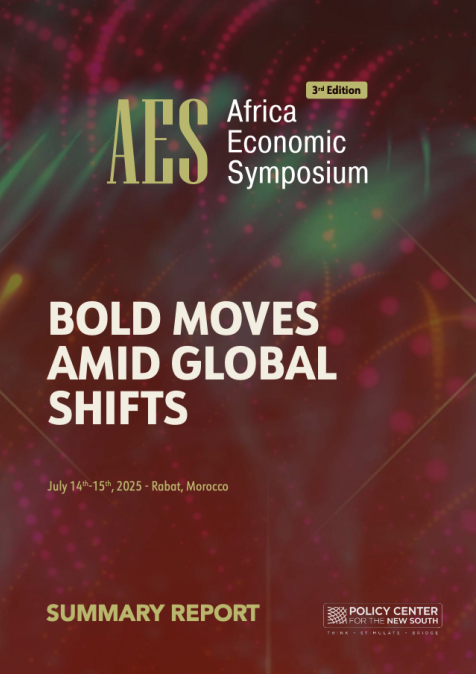
Africa Economic Symposium (AES) 3nd edition - SUMMARY REPORT
Authors
General rapporteur Mahmoud Arbouch
September 2, 2025

The Africa Economic Symposium (AES) has firmly established itself as one of the flagship annual events of the Policy Center for the New South, alongside the Atlantic Dialogues and the African Peace and Security Annual Conference (APSACO). Now in its third edition, AES continues to provide a unique platform for economists, policymakers, and academics from across the continent and beyond to exchange perspectives on the pressing macroeconomic and structural challenges facing Africa. Its mission remains to foster rigorous, evidence-based debates that inform policymaking and support long-term strategies for Africa’s development in an era of uncertainty. 

The 2025 edition, convened under the theme “Bold Moves amid Global Shifts,” explored the difficult policy trade-offs confronting African governments as they navigate a volatile global environment. The continent’s recovery from COVID-19 has been uneven, while debt pressures, supply chain disruptions, and geopolitical tensions weigh heavily on fiscal and economic resilience. Structural challenges such as persistent unemployment, low productivity, and the exclusion of Africa’s youth continue to hinder inclusive growth, even as policymakers are called upon to adapt to deep systemic uncertainty. 

The symposium underscored that many African states are increasingly resorting to short-term stabilization measures—such as accumulating reserves and postponing reforms—that may provide immediate security but risk delaying the structural transformation urgently needed. Against this backdrop, AES 2025 called for a careful balance between fiscal prudence, social investment, and the pursuit of sustainable growth, placing emphasis on reforming governance, improving macroeconomic management, and accelerating structural change. 

The discussions highlighted the urgent need to rethink Africa’s economic strategies in a shifting global order. From debt sustainability and the role of central banks to the promise of financial innovation, digital inclusion, and new instruments such as central bank digital currencies, the symposium emphasized that policy choices must align with long-term transformation goals. The debates also explored the opportunities and challenges of regional integration, trade connectivity, and development finance, all of which are essential levers for Africa’s resilience and prosperity. 

As in previous editions, the Annual Report on African Economies was launched alongside the symposium, offering an in-depth analysis of the continent’s macroeconomic dynamics and structural transformation pathways. More than just a publication, the report reflects the collective intellectual effort of leading scholars and practitioners, providing evidence-based insights to guide decision- makers. Together, the symposium and the report reinforced the Policy Center for the New South’s commitment to fostering forward-looking economic thinking that moves beyond short-term headlines to tackle Africa’s enduring challenges.


RELATED CONTENT

  • October 15, 2026
    The Policy Center for the New South, in partnership with The Asian Network, is organizing a webinar titled “Emerging Powers and the Remaking of Global Order” to examine the growing role of emerging powers and the Global South at a time of profound transformation in the international sys...
  • October 14, 2026
    في ظل التوترات الجيوسياسية المتصاعدة، تتغير طرق التجارة العالمية وتتبدل معها موازين الممرات الاستراتيجية. تفتح هذه الحلقة من «حديث الثلاثاء» النقاش حول التقاء المسارات البحرية والبرية داخل هذه الممرات، والعوامل التي تتحكم في طبيعة السلع التي تعبرها. وتبحث كذلك في ما يمكن للمغرب أن يجنيه...
  • Authors
    October 13, 2026
    “Every gun that is made, every warship launched, every rocket fired signifies in the final sense, a theft from those who hunger and are not fed, those who are cold and are not clothed.”President Dwight Eisenhower, April 16, 1953 This paper examines the economic and human impacts of the first six months of the Iran war—from February to the end of August 2026—on Iran’s Arab neighbors and compares these impacts with those on the three countries directly involved—Iran, Israel and t ...
  • Authors
    Florent Parmentier
    October 12, 2026
    Cet article soutient que le Chief Geopolitical Officer (CGO) doit être repensé à partir de l’expérience des entreprises africaines. Dans un environnement multipolaire et fragmenté, leur principal défi n’est pas seulement la gestion des risques, mais la préservation de plusieurs options stratégiques simultanément selon une logique de hedging. Trois modèles de CGO sont à distinguer : l’intermédiation (Office chérifien des Phosphates (OCP), Tanger Med), l’intégration régionale (Ethiopi ...
  • October 09, 2026
    Can Nigeria’s Dangote refinery help strengthen Africa’s energy security amid disruptions to global supply routes? This discussion considers how expanding local refining capacity can reduc ...
  • Authors
    Paul Isbell
    October 9, 2026
    In the first seven Policy Briefs of this ongoing series of analysis on Pan-Atlanticism: The Atlantic Basin in a Multipolar-Transnational World, we developed the argument that the strategic significance of the Atlantic Basin is on the rise for a range of international actors (states, regions and non-state agents) and from distinct political or ideological perspectives. In addition, in the most recently published Policy Brief -- “The U.S. and the Current International Reconfiguration: ...
  • October 8, 2026
    This paper was originaly published on Higher Education Policy Journal This article critically assesses the alignment between Morocco’s public guidance schemes for international students and its national development goals. Specifically, it investigates the capacity of these mechanisms to transform student mobility from a potential ‘brain drain’ into a tangible ‘brain gain’. Employing a qualitative case study approach, we conducted a systematic content analysis of 204 mobili ...
  • Authors
    Marie-Noelle Nwokolo
    October 6, 2026
    The author of this opinion, Marie-Noelle Nwokolo, is a 2024 alumna of the Atlantic Dialogues Emerging Leaders Program.In September 1978, delegations from 138 countries gathered in Buenos Aires, Argentina, around a powerful idea: developing countries had knowledge, experience and capabilities worth sharing with one another. The Buenos Aires Plan of Action gave institutional form to what we now call South-South Cooperation, part of a wider post-colonial effort by developing ...