Podcasts

Back

Who Will Lead the UN Next? Transparency, Gender, and Geopolitics

17
April 2026
By Gabriela Keseberg Davalos & Chaima Jabbar

The 2026 UN Secretary-General election takes place amid rising conflicts, geopolitical fragmentation, and declining trust in multilateral institutions. These converging crises increase the stakes of leadership at the UN. The process is further shaped by regional dynamics, with Latin America seen as a strong contender, though shifting geopolitical interests—especially from major powers—are complicating the selection.

RELATED CONTENT

  • Authors
    Marianna Albuquerque
    September 23, 2026
    The author of this opinion, Marianna Albuquerque, is a 2022 alumna of the Atlantic Dialogues Emerging Leaders Program.As world leaders gather in New York for the 81st United Nations General Assembly, climate change returns to the center of multilateral diplomacy under markedly different circumstances. The debate is no longer confined to whether the world must decarbonize, but increasingly centers on how the transition will happen, who will bear its costs, who will capture ...
  • Authors
    Stephan Klingebiel
    Andy Sumner
    September 4, 2026
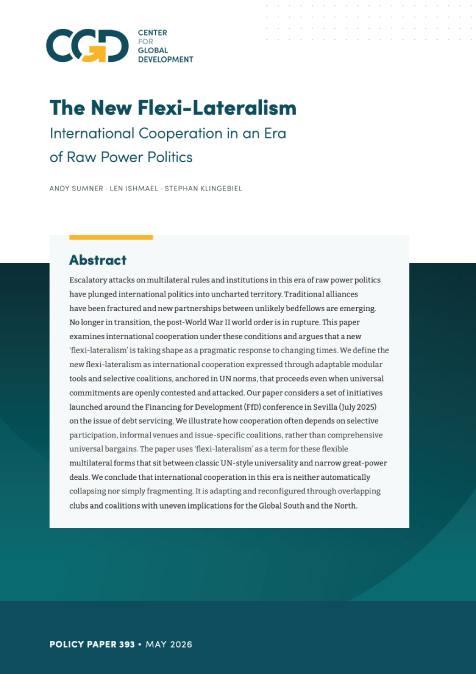
    This Paper was originally published on cgdev.org. Escalatory attacks on multilateral rules and institutions in this era of raw power politics have plunged international politics into uncharted territory. Traditional alliances have been fractured and new partnerships between unlikely bedfellows are emerging. No longer in transition, the post-World War II world order is in rupture. This paper examines international cooperation under these conditions and argues that a new "flexi-l ...
  • August 25, 2026
    Predictions of American decline have become increasingly prevalent. The United States has run persistent trade deficits for decades, but its public debt now exceeds its annual economic output. Meanwhile, and new centers of industrial and technological power continue to emerge across Asia. Yet despite these developments, no country has so far replaced the United States as the main organizing power of the international economy. Conventional explanations explain this in terms of U.S. m ...
  • Authors
    August 13, 2026
    The Resolution adopted by an overwhelming majority of elected European officials in Strasbourg on June 10, 2021, on "the violation of the UN Convention on the Rights of the Child and the exploitation of minors by the authorities in the migration crisis in Ceuta" (2021/2747/RSP), could not fail to leave its mark.Decoding the ResolutionThe Resolution shocked Moroccans to such an extent that it was quickly set aside at the time, as if there were a wish to forget it as fast as possible. ...
  • Authors
    August 11, 2026
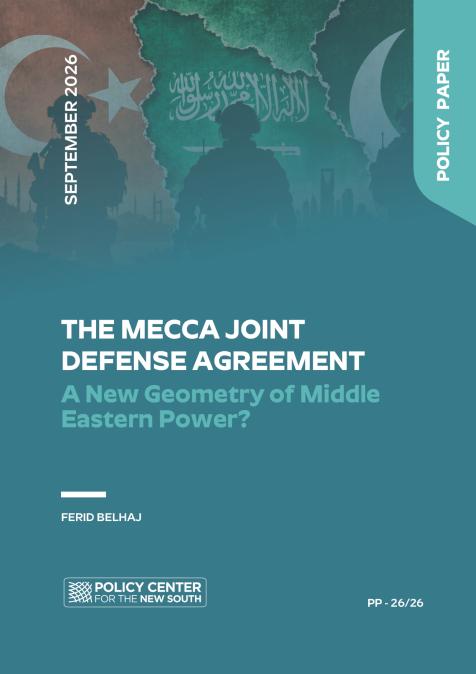
    The Mecca Agreement: A First Step Towards a New Regional Security Architecture? On 7 August, Saudi Arabia, Türkiye and Pakistan signed the Mecca Agreement, a trilateral defense pact aimed at strengthening collective security and defense cooperation between the three countries. At its core lies a collective defense commitment under which an attack on one member is considered an attack on all three. While many details concerning its practical implementation remain unclear, the agreeme ...
  • Authors
    August 7, 2026
    THE END OF AN ERAThe US-Israeli war on Iran, a 'little excursion' envisaged to be over within a matter of weeks, has entered its fourth month. Shock waves ripple across the globe. This war is just one in a series of recent crises which have fractured the international community, making the decades of the 2020's among the most disruptive in recent history. Each crisis compounds the deleterious effects of those which came before. The war in Iran is no exception. It abruptly stalled ec ...
  • Authors
    July 27, 2026
    Is Europe Prepared for War?European public opinion is moving from treating a major conflict as unthinkable to regarding it as a possibility for which governments must prepare. Attention is increasingly focused on Russian hybrid operations, vulnerabilities in critical infrastructure and the risk of fragmentation within NATO. European defence policy is consequently undergoing a rapid transition from post-Cold War complacency towards preparations for high-intensity warfare. Recent ...