Tatiana KASTOUEVA-JEAN, Responsable du centre Russie NEI, Ifri

December 4, 2014
Speakers
Tatiana Kastouéva-Jean
Director, Russia/NIS Center, Ifri
Tatiana Kastouéva-Jean holds a degree from the State University of Ekaterinbourg, a Franco-Russian Master in International Relations from the University of Sciences Po/MGIMO in Moscow, and a DEA (Diplôme d'études approfondies) in International Relations. Among her research areas: evolution of Russian domestic and foreign policies, soft power, Ukraine, education and human capital. She directs the Russie.Nei.Visions. Recent publications include:  « Pourquoi la société russe soutient-elle la politique actuelle du Kremlin ? », Les Études du CERI, Sciences Po, n° 228-229, Regards sur l'Eurasie, février 2017 ; « La Russie après les crises ukrainienne et syrienne », RAMSES 2017, Ifri/Dunod, 2016 ; « Le système Poutine : bâti pour durer ? », Politique étrangère, n°2, 2015 and « R ...

RELATED CONTENT

  • Authors
    Russel Dinh
    January 27, 2016
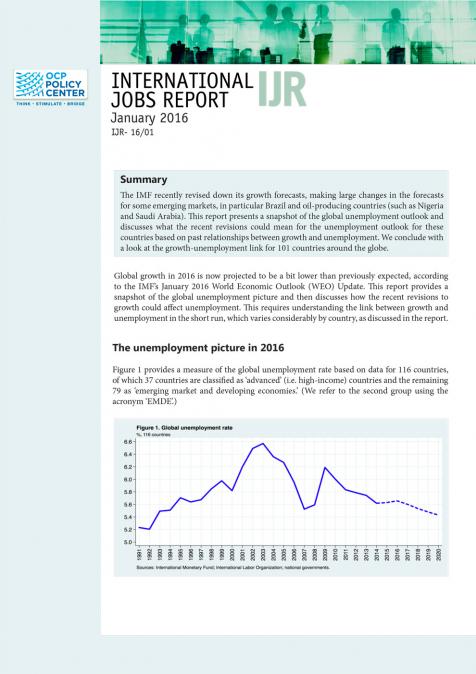
    The IMF recently revised down its growth forecasts, making large changes in the forecasts for some emerging markets, in particular Brazil and oil-producing countries (such as Nigeria and Saudi Arabia). This report presents a snapshot of the global unemployment outlook and discusses what the recent revisions could mean for the unemployment outlook for these countries based on past relationships between growth and unemployment. We conclude with a look at the growth-unemployment link f ...
  • May 2, 2014
    The financial and economic crisis that unfolded across the globe after the 2008 sub-prime meltdown was not just another cyclical bump in the conquering advance of modern capitalism. It was — and still is — a symptom of the exhausted 20th-century way of envisioning the best path to economic growth, consumer satisfaction, and efficient production of goods. Environmental limits to our race to prosperity are just part of the story. The other, and crucial, part is the ongoing technologic ...
  • From

    06
    11:00 am October 2026
    Dans un environnement international reconfiguré, les économies à revenu intermédiaire poursuivent leur processus de convergence dans des conditions plus exigeantes. La fragmentation géopolitique et la réorganisation des chaînes de valeur mondiales modifient les logiques d'insertion productive, tandis que les tensions sur le système monétaire international pèsent sur le financement des économies en développement. L'accélération des transitions technologique et énergétique redistribue par ailleurs les avantages comparatifs et exige des capacités d'adaptation que tous les pays ne peuvent mobiliser au même degré. Les moteurs classiques du rattrapage se trouvent fragilisés, et le risque d'enlisement dans le piège du revenu intermédiaire se pose de manière plus pressante.C'est dans ...