Regards croisés sur la mise en œuvre du Nouveau Modèle de Développement - Session II

December 2, 2021

Cycle de Conférences : Regards croisés sur la mise en œuvre du Nouveau Modèle de Développement - Session II : Gestion macroéconomique et réformes sectorielles La deuxième session du cycle de conférences qu’organise le Policy Center for the New South sur la mise en œuvre du Nouveau Modèle de Développement (NMD) portera sur la gestion macroéconomique et les réformes sectorielles. Dans son diagnostic sur les conditions macro-économiques de la croissance, le Rapport sur le NMD a relevé que la stabilité macro-économique sur la dernière décennie n’a pas suffisamment porté la dynamique de développement. En témoignent le rythme lent de la croissance et la faible création d’emplois. Cette dynamique atone n’est pas sans lien avec la nature même des politiques macro-économiques jusque-là poursuivies. Considérées trop restrictives, soumises à des normes rigides, elles auraient privé le pays de l’exploitation des marges de manœuvre. Le projet du NMD avance une série de propositions pour infléchir les politiques budgétaires et monétaires et orienter la politique de change en vue de déclencher un cercle vertueux de développement. Ces propositions suscitent un débat sur la nature des politiques macro-économiques susceptibles d’élargir les marges de manœuvres, tout en garantissant la stabilité des comptes internes et externes et consolider la confiance des acteurs économiques. Deux enjeux de taille traversent la mise en œuvre de ces propositions. D’un côté le financement du modèle qui reste assujetti aux impératifs de l’engagement de la réforme fiscale et de la rationalisation de la politique actionnariale de l’Etat pour en faire un vecteur de création de valeur économique et sociale. De l’autre côté, l’accélération des dynamiques sectorielles pour lesquelles le Maroc dispose d’avantages comparatifs, dans le cadre de visions stratégiques à moyen et long termes pour contribuer à la consolidation de la stabilité macroéconomique et soutenir la croissance

Speakers
Abdelaaziz Ait Ali
Head - Research in Economics
Abdelaaziz Ait Ali is a principal Economist and head of the Research Department at the Policy Center for the New South. He joined the Center in 2014 after five years of experience at the Central Bank of Morocco. He worked as an economist in the International Studies and Relations Department and was analyzing the real estate price index and financial asset prices for monetary policy and financial stability purposes. Since then, Abdelaaziz has focused on cyclical and structural issues of the Moroccan economy, including macroeconomic management and industrial policy design. He has published articles on the reform of the exchange rate regime in the Moroccan economy and its implications for macroeconomic regulation, as well as on the evolution of the macroeconomic framework over th ...
Mohammed Benmoussa
Affiliate Professor, Mohammed VI Polytechnic University, Rabat
Mohammed Benmoussa is a Moroccan economist and senior consultant in economic policy, taxation, and public finance, as well as a former banker and capital market practitioner. He is Professor of Corporate and Market Finance at Mohammed VI Polytechnic University. In December 2019, he was appointed by HM King Mohammed VI to the Special Commission on the New Development Model. He is also President of the Forum of Progressive Economists, President of the Damir Movement and the La Samir Front. He previously served as President of the Brokerage Firms Association and Vice-President of the Casablanca Stock Exchange. ...
Fathallah Oualalou
Senior Fellow
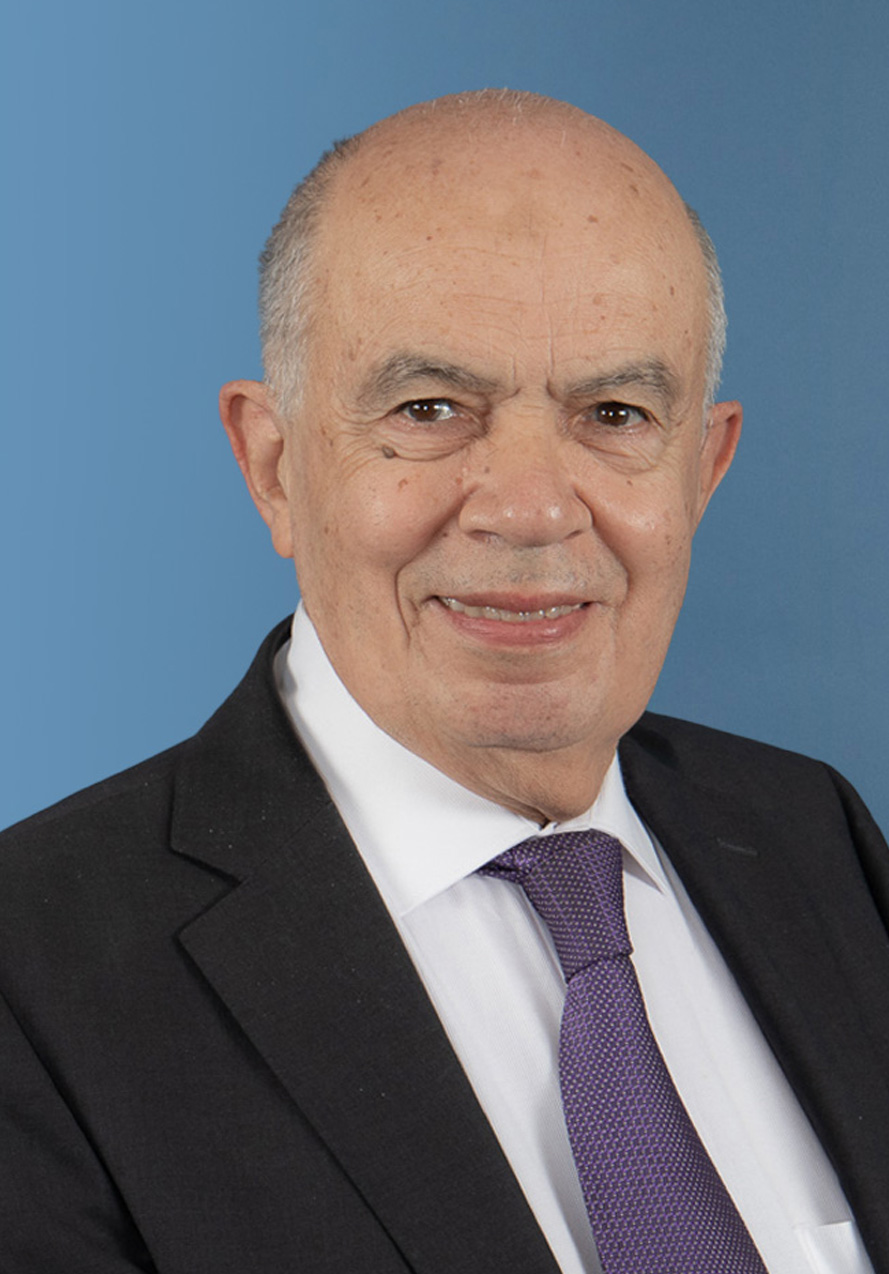
Fathallah Oualalou is an economist, Senior Fellow at the Policy Center for the New South.  He obtained his PhD in economics from the University of Paris in 1968. Prior to joining the Policy Center for the New South, he served as a professor at Mohammed V University in Rabat and other higher education institutions in Morocco, and as an associate professor at several foreign universities. He is the author of numerous books and articles in the fields of economic theory, financial economics, international economic relations, the economies of Maghreb countries, the Arab world, and the Euro-Mediterranean area. In addition, he was the president of the Association of Moroccan Economists at the Union of Arab Economists. His political activism began with the creation, in the 1960 ...
Mohammed Chiguer
Président du Centre d’Etudes et de Recherches Aziz Belal (CERAB)
Docteur en économie, ancien directeur des études et du contrôle de gestion à la Caisse de dépôt et de gestion (CDG), professeur visiter, CHIGUER Mohammed est aussi président du Centre d’Etudes et de Recherches Aziz Belal (CERAB). Il a déjà publié plusieurs ouvrages, en arabe et en français, dont « Philosophie, science et économie : éléments pour l’analyse du modèle civilisationnel occidental », « Pensée piégée, Islam et modernité », « الإقتصاد المغربي » et « ما المثقف؟ ». Dans cet ouvrage, l’auteur poursuit le travail de réflexion, entamé depuis le début des années 80 du siècle dernier, qui consiste à repositionner l’Economie pour en faire une composante du phénomène social. ...

RELATED CONTENT

  • Authors
    Luladay Berhanu Mengistie
    Guillaume Gérout Suominen
    September 21, 2026
    The African Union Summit of February 2026 instructed the African Continental Free Trade Area (AfCFTA) Council of Ministers to negotiate a Protocol on Industrial Policy and Development. This work, handled without adequate preparation, is likely to reproduce the weaknesses it is meant to remedy. This paper is a conceptual mapping exercise, written to raise the preparatory questions before drafting begins, rather than to prescribe outcomes.It proceeds in five sections:1. It works towar ...
  • Authors
    Pedro Henrique de Christo
    Travis Knoll
    September 18, 2026
    The Brazilian context involving a clean-electricity base, a more balanced lobbying landscape, and mounting climate and social pressure, makes it more difficult for the kind of abrupt and unrestrained energy policy swing seen in Colombia. The trend in Brazil tends to be more economically viable for renewables. However, these structural conditions by themselves will not guarantee the success of the transition. Fruition will depend on whether policymakers use this window to prepare for ...
  • September 11, 2026
    Le marché du travail marocain connaît, depuis les années 2000, une expansion continue de la scolarisation qui ne s'est pas accompagnée d'une transformation équivalente de la structure productive de l'économie, ouvrant la voie à des situations d'inadéquation verticale entre le niveau de formation des actifs occupés et les exigences des emplois qu'ils occupent. La présente étude analyse les déterminants du déclassement (sur-éducation) et du surclassement (sous- éducation) à partir des ...
  • September 11, 2026
    Since the early 2000s, the Moroccan labour market has experienced continuous educational expansion that has not been matched by an equivalent transformation of the economy's productive structure, giving rise to situations of vertical mismatch between employed workers' education levels and the requirements of the jobs they hold. This study analyzes the determinants of overeducation and undereducation using anonymized microdata from the 2014 General Population and Housing Census (RGPH ...
  • Authors
    September 9, 2026
    This paper was originally published as a chapter in the ISPI report The Pursuit of Smart Mobility in Urban Nodes: Trends and Innovation for Citizens and Freight. Agglomeration economies have historically supported industrialisation and global integration by concentrating firms, labour and infrastructure in dynamic urban cores. However, these same forces have also generated persistent patterns of territorial polarisation. Drawing on New Economic Geography, this chapter interpret ...
  • Authors
    Stephan Klingebiel
    Andy Sumner
    September 4, 2026
    This Paper was originally published on cgdev.org. Escalatory attacks on multilateral rules and institutions in this era of raw power politics have plunged international politics into uncharted territory. Traditional alliances have been fractured and new partnerships between unlikely bedfellows are emerging. No longer in transition, the post-World War II world order is in rupture. This paper examines international cooperation under these conditions and argues that a new "flexi-l ...
  • Authors
    September 3, 2026
    “A band-aid on a bullet hole!” That’s how Charlie McElligott, a cross-asset strategist at Nomura, described the maneuver carried out by United States Treasury Secretary Scott Bessent on August 19. The U.S. Treasury Department announced that from September 9 to November 4, it would double the volume of long-term bond buybacks, going from $2 billion to at least $4 billion per operation, with a focus on maturities of between 10 and 30 years. ...
  • August 28, 2026
    يستضيف بودكاست مركز سياسات من أجل الجنوب الجديد الباحث البارز حافظ غانم للحديث عن العلاقة الدائرية بين عدم المساواة وضعف الإنتاجية في بلدان الجنوب الجديد، حيث يغذي كل منهما الآخر في نوع م ...