Marie-Claire AOUN, Directrice, centre Energie, Ifri

January 16, 2015

Les ressources énergétiques et les enjeux de la gestion de leurs revenus Roundtable website: http://bit.ly/Energy_13jan2015

Speakers

Marie-Claire Aoun
Director of the Energy Center at IFRI
Marie-Claire Aoun est directrice du centre Energie de l’Ifri et enseignante à l’Université Paris Dauphine. Elle débute sa carrière en 2004 au Centre de Géopolitique de l’Énergie et des Matières premières (CGEMP). Marie-Claire Aoun est titulaire d’un Doctorat en Sciences économiques de l’Université Paris Dauphine (2008), auteure d’une thèse portant sur la rente pétrolière et le développement économique des pays exportateurs de pétrole. Entre 2008 et début 2014, elle est Economiste à la Commission de Régulation de l’Énergie (CRE), où elle contribue aux travaux sur la mise en œuvre du troisième paquet législatif de l’énergie et sur l’intégration des marchés du gaz en Europe. Elle a notamment été impliquée dans les travaux sur les mécanismes d’allocation des capacités de transpor ...

RELATED CONTENT

  • Authors
    Sabrina Camélia Pagop
    Luc Savard
    April 29, 2024
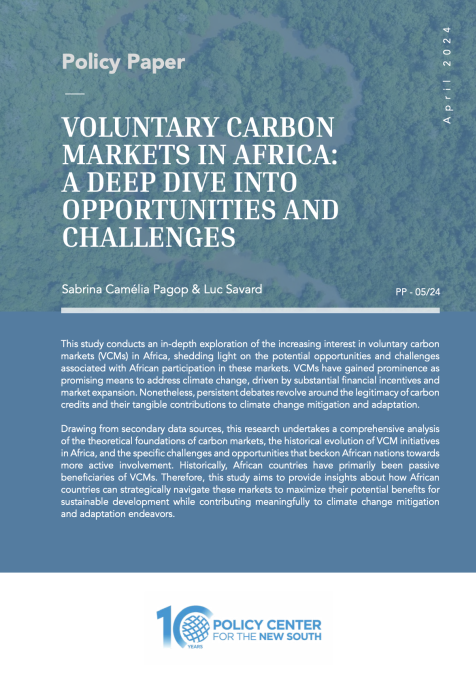
    This study conducts an in-depth exploration of the increasing interest in voluntary carbon markets (VCMs) in Africa, shedding light on the potential opportunities and challenges associated with African participation in these markets. VCMs have gained prominence as promising means to address climate change, driven by substantial financial incentives and market expansion. Nonetheless, persistent debates revolve around the legitimacy of carbon credits and their tangible contributions t ...
  • Authors
    Miguel Vazquez
    March 26, 2024
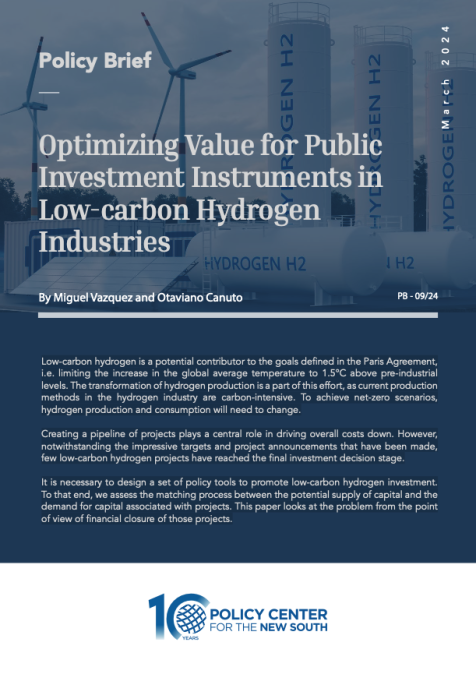
    Low-carbon hydrogen is a potential contributor to the goals defined in the Paris Agreement, i.e. limiting the increase in the global average temperature to 1.5°C above pre-industrial levels. The transformation of hydrogen production is a part of this effort, as current production methods in the hydrogen industry are carbon-intensive. To achieve net-zero scenarios, hydrogen production and consumption will need to change. Creating a pipeline of projects plays a central role in drivin ...
  • Authors
    March 19, 2024
    Par rapport aux intérêts des générations des années cinquante, soixante et soixante-dix (dont je fais partie), la question de l’environnement n’est venue se greffer dans les préoccupations des acteurs, leurs réflexions et programmes d’action, que tardivement. Il faudra encore quelque temps pour mûrir les éléments de cette problématique relativement nouvelle. Toutefois, dès le départ on est partagé entre deux visions : d’une part, une approche qui considère la protection de l’ ...
  • Authors
    February 13, 2024
    As a net energy importer seeking to improve its energy security, Morocco has stepped up initiatives to achieve a level of domestic energy sovereignty. This includes following guidelines for transitioning to cleaner energy sources, with an emphasis on diversification. This diversification extends to natural gas, solar and wind power, and innovative solutions such as green hydrogen. Morocco recognizes cooperation as a crucial element for the success of its strategies, as underlined by ...
  • February 8, 2024
    In this episode, we examine the state of energy integration in Africa, a continent striving for both sustainable development and industrialization. We delve into the current challenges, the tension between renewable energy and fossil fuels. Ultimately, the episode sheds light on the int...