Marie-Claire Aoun, Director of the Energy Center at IFRI

September 29, 2014

Marie-Claire Aoun, Director of the Energy Center at the Institut Français des Relations Internationales at the International Seminar on Morocco’s Role in Fostering Euro-Mediterranean Energy Cooperation

Speakers

Marie-Claire Aoun
Director of the Energy Center at IFRI
Marie-Claire Aoun est directrice du centre Energie de l’Ifri et enseignante à l’Université Paris Dauphine. Elle débute sa carrière en 2004 au Centre de Géopolitique de l’Énergie et des Matières premières (CGEMP). Marie-Claire Aoun est titulaire d’un Doctorat en Sciences économiques de l’Université Paris Dauphine (2008), auteure d’une thèse portant sur la rente pétrolière et le développement économique des pays exportateurs de pétrole. Entre 2008 et début 2014, elle est Economiste à la Commission de Régulation de l’Énergie (CRE), où elle contribue aux travaux sur la mise en œuvre du troisième paquet législatif de l’énergie et sur l’intégration des marchés du gaz en Europe. Elle a notamment été impliquée dans les travaux sur les mécanismes d’allocation des capacités de transpor ...

RELATED CONTENT

  • October 14, 2026
    في ظل التوترات الجيوسياسية المتصاعدة، تتغير طرق التجارة العالمية وتتبدل معها موازين الممرات الاستراتيجية. تفتح هذه الحلقة من «حديث الثلاثاء» النقاش حول التقاء المسارات البحرية والبرية داخل هذه الممرات، والعوامل التي تتحكم في طبيعة السلع التي تعبرها. وتبحث كذلك في ما يمكن للمغرب أن يجنيه...
  • September 24, 2025
    This episode explores how green hydrogen can drive Morocco’s energy transition and economic development, with a focus on export opportunities to Europe, integration into industrial value chains, and the development of supporting infrastructure. It highlights financing mechanisms and tec...
  • Authors
    September 15, 2023
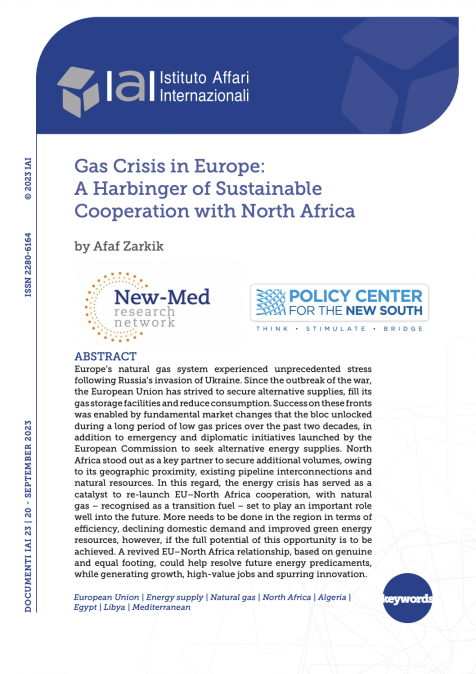
    This paper was originally published on iai.it Europe’s natural gas system experienced unprecedented stress following Russia’s invasion of Ukraine. Since the outbreak of the war, the European Union has strived to secure alternative supplies, fill its gas storage facilities and reduce consumption. Success on these fronts was enabled by fundamental market changes that the bloc unlocked during a long period of low gas prices over the past two decades, in addition to emergency and ...
  • Authors
    Abdelmonim AMACHRAA
    May 17, 2023
    Nothing better illustrates the positive contribution of the integration of national economies into global value chains than the fact that in the 1990s, the automotive sector barely existed in Morocco. Now, it is the leading export sector, with a production and assembly capacity of 700,000 vehicles, making it an attractive and competitive hub linking Africa and Europe in the automotive value chain. However, the automotive industry is on the cusp of change, with advances in electric a ...
  • October 25, 2022
    واجه الاتحاد الأوروبي خلال السنتين الماضيتين أزمة غير مسبقة في قطاع الطاقة بدأت منذ سنة 2021 واشتدت مع الأزمة الروسية الأوكرانية. فارتفعت أسعار الطاقة عمومًا والغاز على وجه الخصوص ممّا تسبّب في ضغطات مرتفعة على الفاعلين الاقتصاديين مستهلكين كانوا ام شركات. فحاول المفوضية والمجلس الأوروب...
  • February 28, 2022
    La guerre russo-ukrainienne aura des répercussions économiques et politiques dans les années à venir. Dans cette note, nous nous intéressons aux implications économiques de la guerre sur l’économie africaine à court et à long terme. Le conflit survient alors que l’Afrique s’efforce de mettre son économie sur la voie de la reprise, dans un contexte de pressions inflationnistes mondiales et de volatilité des marchés financiers et des matières premières. Alors que les exportateurs d’én ...
  • February 28, 2022
    The Russian-Ukrainian war will have major economic and political repercussions. In this note, we focus on the war’s economic short and long term implications on the African economy. This conflict comes at very arduous context, where Africa is still struggling to set its economy on the recovery path, amid global inflationary pressures and highly uncertain context. While natural resources countries, especially energy exporters, are sensing opportunities from the crisis, other countrie ...
  • October 15, 2021
    The European Commission recently presented several legislative proposals as part of its “Fit for 55” initiative, designed to accelerate the reduction of greenhouse gas emissions and achieve carbon neutrality by 2050. A Carbon Border Adjustment Mechanism (CBAM) has been proposed as part of this initiative. The CBAM would be complementary to the EU’s Emission Trading Scheme (ETS), involving CBAM certificates issued to importers based on the integrated emissions intensity of the produc ...