Publications /
Opinion

A clear African perspective and a candid debate… This is how the 6th edition of the Atlantic Dialogues high-level conference, organized by the Moroccan think tank OCP Policy Center in Marrakech, has started this morning. The six authors of the 2017 edition of the annual report Atlantic Currents, published by the OCP Policy Center, have debated with the room - some 350 participants - on the crucial questions of African migration, economic integration, and the possibilities of a continental response to terrorism.
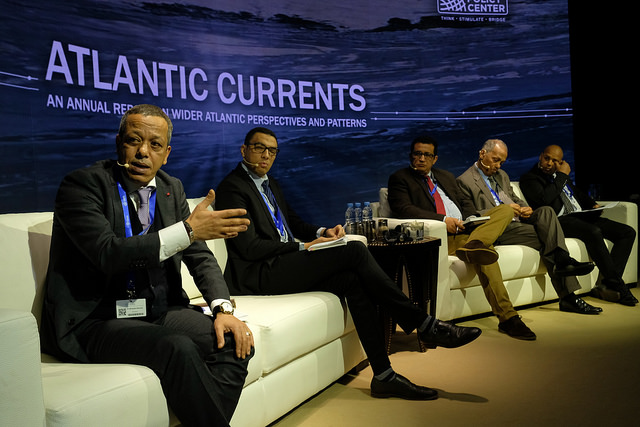
The main focus of the conference was also at stake : « Africa in the Atlantic », this year’s theme of the Atlantic Dialogues. According to Rachid El Houdaigui, Professor of International Relations at Abdelmalek Essaadi University (Tangier) and Senior Fellow at OCP Policy Center « Africa has hardly started to think its maritime geopolitics and geoeconomics ». Different factors may explain this situation : other priorities at a governmental level and weak public policies capacities, with persistant perceptions coming from the former colonial powers on what Africa is all about - mainly land and not water. Also underlined in the report Atlantic Currents, the blatant importance of a foreign economic and military presence on the African Atlantic shores has been discussed.
“How can I be rising if DRC cannot make its own telephones?”
In his keynote speech, Karim El Aynaoui, Director of the OCP Policy Center, defined the aim of the conference : « We seek an inter-generational balance, with the presence of 50 Emerging Leaders engaging with their elders, and the South-North, balance, with a conversation between all the perspectives and points of view ».
The opening conversation of the AD 2017 Conference started with a talk around the crucial question of perceptions. Entitled « Africa owns its narrative », this session has gone straight into the heart of the matter. « The narrative on Africa still doesn't come from the continent but elsewhere, stated Njoya Tikum (Cameroon), regional anti-corruption and economic governance policy advisor for the United Nations Development Programme (UNDP) in Addis Abeba. When The Economist issued a cover on “Africa, the hopeless continent", it took us ten year to get out of that perception. Now, we are “rising”... How can I be rising if the Democratic Republic of Congo (DRC) cannot make its own telephones with all its coltan? Or if Ivory Coast produces 99 % of the world's cocoa but doesn't do anything out of it, leaving the profits of chocolate to Germany ?»
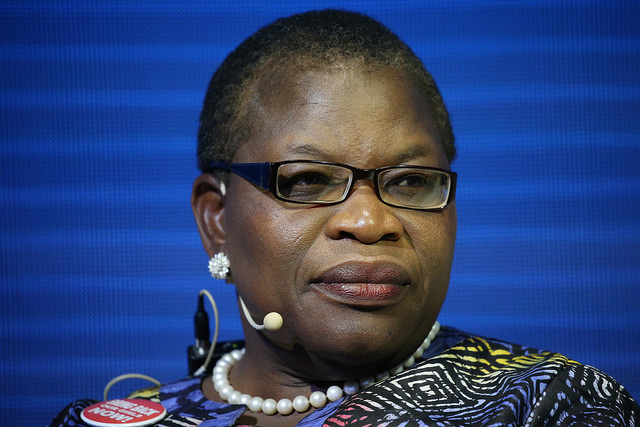
Oby Ezekwesili (Nigeria), co-founder of Transparency International and Senior Advisor for Africa Economic Development & Policy Initiative, agreed on that. « We cannot yet afford to be triomphalist about the performance of the last decade. Africa has had growth, but did not make the transition from a commodity-based economy to manufacturing and services. That is where the challenge lies. It's not all doom for us. If we can fix our politics, we will move fast.»
Reflecting on the « maturation process » of African democracies, she stated without complacency that « sooner or later, the politics will no longer be determined by a club of parasite elite who act like a criminal gang on our continent, but by citizens! » A loud round of applause followed.
Rwanda and Ethiopia, two African exceptions ?
Alan Kasujja, famous presenter from BBC Newsday, mentioned without naming them « two countries who are doing best in Africa but are bashed by the West » and asked this provocative question : « Does Africa understand its own political solutions ? »… Njoya Tikum replied that « countries like Rwanda and Ethiopia did not base their plans on what Japan or France think. They have their vision and their own narrative. But overall, in Africa, we still have this feeling that our confidence, our energies have to be tied in one way or another to our external influences ». Aminata Touré, former Prime Minister of Senegal, made this comment from the floor : « Africa must be proud of itself and stop being the crying continent ».
Troughout the day, with Plenary Sessions on « The State of the World Economy and its Implications for Development » and « Exploiting the Economic Potential of Africa and its Global Links », the same reflexions on the key issue of governance were formulated. Former IMF Director and French economist Dominique Strauss-Kahn has drawn uncertain perspectives in the long term because of « rising inequalities between and within countries, low wages, lowering labour productivity and finance (linked to the Latin American debt and the Chinese financial excesses)».
Later in the afternoon, after a remark coming from the floor about the legacy left by slavery and colonization on Africa, Laoye Jaiyeola, CEO of the Nigerian Economic Summit Group, replied sharply : « Africa is responsible for its problems ! Political leadership is something we need to revisit without talking about A, B or C. I won’t need to go to England if the health, school and business environment is good in my country ! Our problem is that there’s no inclusion, people are hungry and poor, small farmers need agricultural systems to process their production and stop the harvest losses (40 % in Nigeria) because there’s no infrastructures giving them access to the markets. We just need to start processing our raw materials ! With the right leadership, in 10 years from now, we could solve the problems in Africa ! » This frank conversation, a sign of changing times, went on during the last two Plenary Sessions of the day on « Agricultural Policy in Africa and Technological Change » and « Bridging Africa’s Financing Gap: New Actors, Longstanding Challenges », before a large bouquet of 11 Breakout Dinners.
Oby Ezekwesili
“What are we doing to ourselves ?”
The Nigerian co-founder of Transparency International, former Vice-President of the World Bank and Senior Advisor for Africa Economic Development & Policy Initiative has been one of the stars of this first day of AD 2017, with her many interventions.
During a Plenary Session on « Exploiting the Economic Potential of Africa and its Global Links », she went into debate with the remark coming from the floor on the legacy left by centuries of colonization and slave trade. Far from the ritual posture of lamentation adopted for decades by the Francophone zone in Africa, she replied :
« I won’t spend my time discussing what was done to us, but what we are doing to ourselves. That’s a major point of interest for me ! Historical things are part of history. We certainly need to learn the lessons of the past and know about the bad things one region has done to another region in this world. If we are to talk about unlocking Africa’s potential, we need some forward thinking.
Africa’s economic performance improves on the tail of the ICT revolution ! Africa was not part of the agrarian revolution or the industrial revolution, but takes part in the ICT revolution with billion of phone lines and the way it consumes ICT.
What if Africa starts to participate fully in the ICT innovation – to get out of the mess of its political failure, because if you cross the Mediterranean Sea you are still considering the risks of dying as lower than staying on the continent… How de we get governance to be effective enough and optimize the factors ?»