Publications /
Policy Brief
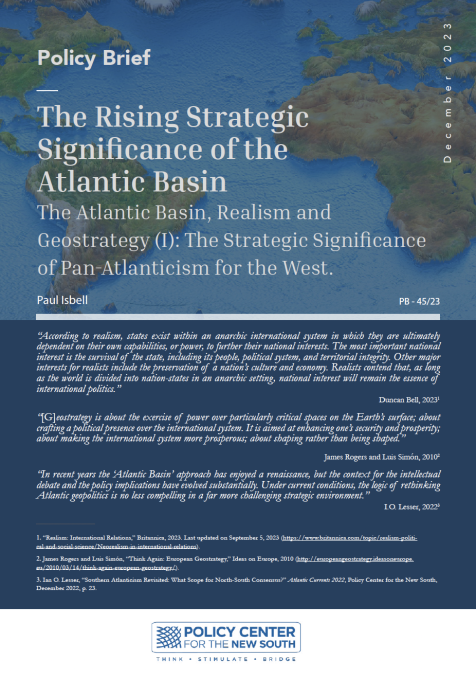
“According to realism, states exist within an anarchic international system in which they are ultimately dependent on their own capabilities, or power, to further their national interests. The most important national interest is the survival of the state, including its people, political system, and territorial integrity. Other major interests for realists include the preservation of a nation’s culture and economy. Realists contend that, as long as the world is divided into nation-states in an anarchic setting, national interest will remain the essence of international politics.”
Duncan Bell, 2023[1]
“[G]eostrategy is about the exercise of power over particularly critical spaces on the Earth's surface; about crafting a political presence over the international system. It is aimed at enhancing one's security and prosperity; about making the international system more prosperous; about shaping rather than being shaped.”
James Rogers and Luis Simón, 2010[2]
“In recent years the ‘Atlantic Basin’ approach has enjoyed a renaissance, but the context for the intellectual debate and the policy implications have evolved substantially. Under current conditions, the logic of rethinking Atlantic geopolitics is no less compelling in a far more challenging strategic environment.”
I.O. Lesser, 2022[3]
[1] “Realism: International Relations,” Britannica, 2023. Last updated on September 5, 2023 (https://www.britannica.com/topic/realism-political-and-social-science/Neorealism-in-international-relations).
[2] James Rogers and Luis Simón, "Think Again: European Geostrategy," Ideas on Europe, 2010 (http://europeangeostrategy.ideasoneurope.eu/2010/03/14/think-again-european-geostrategy/).
[3] Ian O. Lesser, “Southern Atlanticism Revisited: What Scope for North-South Consensus?” Atlantic Currents 2022, Policy Center for the New South, December 2022, p. 23.