Publications /
Paper in Academic Journals

Back
Regional economic impact of COVID-19 in Colombia: An input–output approach
Authors
Jaime Bonet-Morón
Diana Ricciulli-Marín
Gerson Javier Pérez-Valbuena
Luis Armando Galvis-Aponte
Inácio F. Araújo
Fernando S. Perobelli
July 29, 2020

The aim of this paper is to assess the regional economic impact of the lockdown measures ordered by the national government to prevent the spread of COVID-19. Using an input–output model, we estimate the economic loss of extracting groups of formal and informal workers from different economic sectors. Results show monthly economic losses that represent between 0.5% and 6.1% of national GDP, depending on the scenario considered. Accommodation and food services, real estate, administrative services, construction and trade are the most affected sectors. Regionally, Antioquia, Boyacá, San Andrés, Santander and Valle del Cauca appear as highly vulnerable to these restrictions.

RELATED CONTENT

  • Authors
    Ana Maria Bonomi Barufi
    Peter Nijkamp
    May 27, 2016
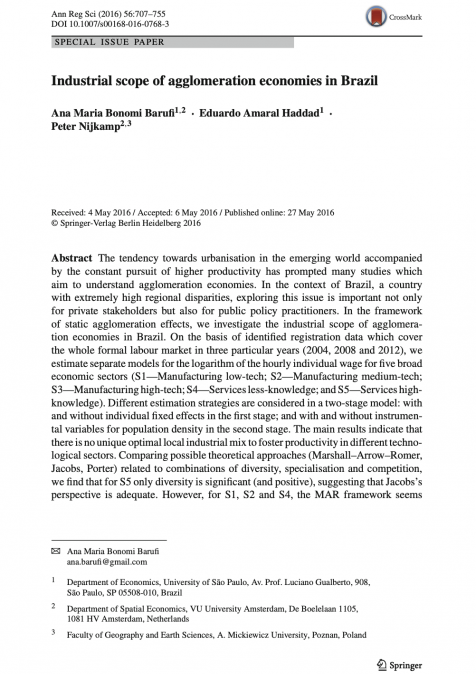
    The tendency towards urbanisation in the emerging world accompanied by the constant pursuit of higher productivity has prompted many studies which aim to understand agglomeration economies. In the context of Brazil, a country with extremely high regional disparities, exploring this issue is important not only for private stakeholders but also for public policy practitioners. In the framework of static agglomeration effects, we investigate the industrial scope of agglomeration econom ...
  • Authors
    Otávio José Guerci SIDONE
    Jesús Pascual MENA-CHALCO
    April 6, 2016
    A recente evolução da ciência brasileira é caracterizada pelo crescimento acelerado da produção científica e pela intensificação da colaboração entre seus pesquisadores. Este trabalho tem por objetivo apresentar elementos sobre o papel da geografia na evolução da produção e colaboração científica no Brasil entre 1992 e 2009, por meio da identificação de padrões espaciais e da importância relativa das regiões em termos de produção, especialização científica e grau de interação colabo ...
  • Authors
    February 10, 2015
    Manufacturing is declining as a share of GDP not only in advanced countries, but in developing countries as well. This new trend, a result of complex forces, should be seen on balance as a reason for development-optimism, not pessimism. In the 21st century economy, manufacturing remains important, but poor countries can attract investment, grow rapidly and diversify away from agriculture on the basis of many possible sources of comparative advantage, without artificially promoting m ...