Publications /
Policy Brief

Back
Potash: a typical price war
Authors
March 8, 2016

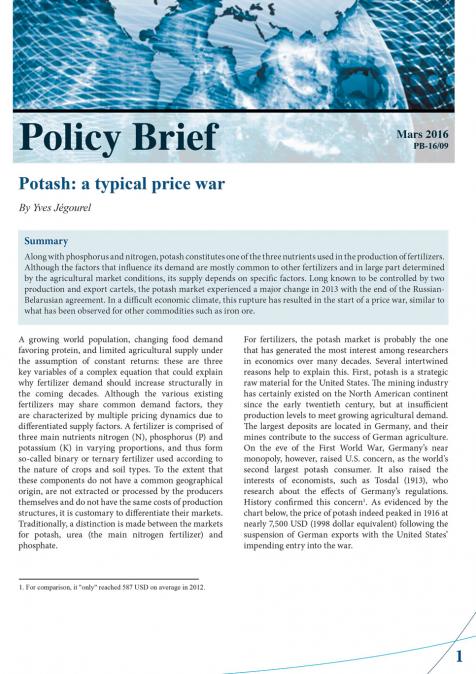
Along with phosphorus and nitrogen, potash constitutes one of the three nutrients used in the production of fertilizers. Although the factors that influence its demand are mostly common to other fertilizers and in large part determined by the agricultural market conditions, its supply depends on specific factors. Long known to be controlled by two production and export cartels, the potash market experienced a major change in 2013 with the end of the RussianBelarusian agreement. In a difficult economic climate, this rupture has resulted in the start of a price war, similar to what has been observed for other commodities such as iron ore.

RELATED CONTENT

  • Authors
    December 14, 2015
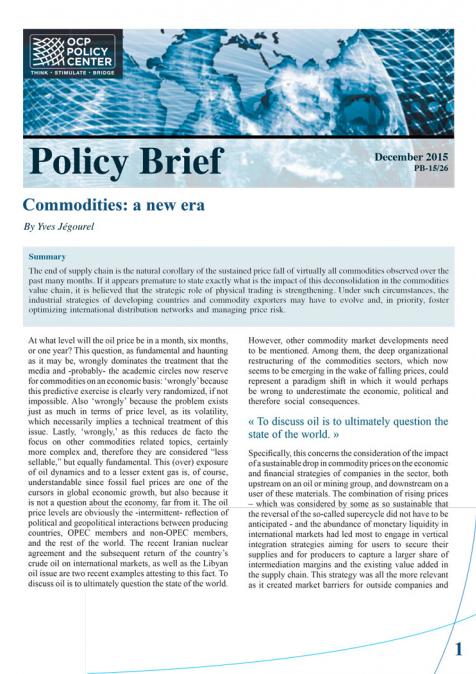
    The end of supply chain is the natural corollary of the sustained price fall of virtually all commodities observed over the past many months. If it appears premature to state exactly what is the impact of this deconsolidation in the commodities value chain, it is believed that the strategic role of physical trading is strengthening. Under such circumstances, the industrial strategies of developing countries and commodity exporters may have to evolve and, in priority, foster optimizi ...
  • Authors
    February 10, 2015
    Manufacturing is declining as a share of GDP not only in advanced countries, but in developing countries as well. This new trend, a result of complex forces, should be seen on balance as a reason for development-optimism, not pessimism. In the 21st century economy, manufacturing remains important, but poor countries can attract investment, grow rapidly and diversify away from agriculture on the basis of many possible sources of comparative advantage, without artificially promoting m ...