Publications /
Policy Brief

Back
Multilateralism: what is the political (geo) resonance for steel?
Authors
January 12, 2017

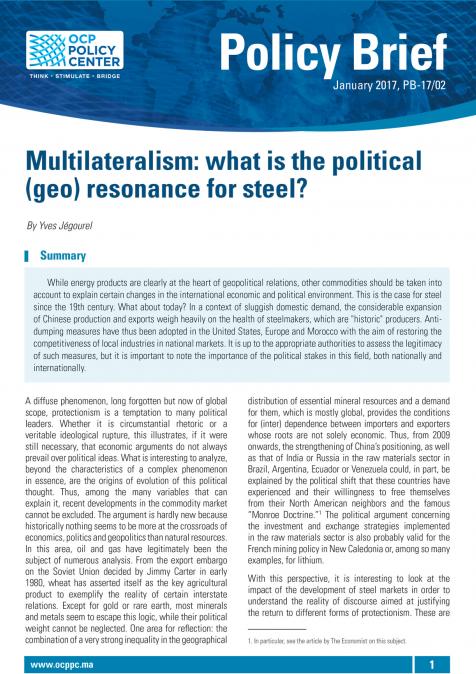
While energy products are clearly at the heart of geopolitical relations, other commodities should be taken into account to explain certain changes in the international economic and political environment. This is the case for steel since the 19th century. What about today? In a context of sluggish domestic demand, the considerable expansion of Chinese production and exports weigh heavily on the health of steelmakers, which are "historic" producers. Antidumping measures have thus been adopted in the United States, Europe and Morocco with the aim of restoring the competitiveness of local industries in national markets. It is up to the appropriate authorities to assess the legitimacy of such measures, but it is important to note the importance of the political stakes in this field, both nationally and internationally.

RELATED CONTENT

  • Authors
    February 11, 2026
    The U.S.–China technological rivalry has become a central axis of global economic and geopolitical competition. While the United States continues to lead in frontier innovation—most notably in advanced semiconductors and artificial intelligence (AI)—China has consolidated strengths in large-scale implementation, manufacturing capacity, and control over critical segments of global supply chains. These advantages are especially visible in clean energy technologies and in the processin ...
  • Authors
    February 3, 2026
    From the use of tariffs as a foreign policy instrument, to the weaponization of critical resources, and from targeted sanctions to attacks on critical infrastructure, economic security is at the forefront of international debates. The aggressive use of economic instruments for strategic purposes has become an explicit feature of international affairs, in a way not seen since the interwar period[1]. Beyond the weaponization of resources of all kinds, an increasing ‘monetization’ is u ...
  • Authors
    January 21, 2026
    In response to developing countries’ dissatisfaction with the New Collective Quantified Goal (NCQG) of $300 billion, which was decided at the Twenty-Ninth Conference Of the Parties (COP29) to the United Nations Framework Convention on Climate Change, in 2024 in Baku, Azerbaijan, the COP29 and COP30 presidencies promised to develop a roadmap to achieve $1.3 trillion in external climate finance that developing countries need, and to present it at COP30 in Belém, Brazil[1]. The two pre ...
  • January 2, 2026
    Ce Policy Paper analyse les enjeux politiques, économiques et opérationnels du Fonds pour les pertes et dommages, créé pour répondre aux impacts climatiques irréversibles subis par les pays les plus vulnérables. Il clarifie d’abord la notion de pertes et dommages, qui mêle effets économiques et non économiques, et souligne les défis d’attribution liés à la superposition entre chocs climatiques et fragilités structurelles. L’analyse met ensuite en lumière les tensions d’économie poli ...
  • Authors
    Nizar Messari
    December 19, 2025
    The U.S. military buildup in the Caribbean—the most significant since the Cuban Missile Crisis—comes at a moment when a new world order is taking shape, its contours still unclear, and in which the U.S. seeks to be more assertive in the Western Hemisphere. This disposition toward South America and the Caribbean was underscored by the recent publication of the new U.S. National Security Strategy, in which the Monroe Doctrine is explicitly invoked. This Policy Brief situates the devel ...
  • August 18, 2025
    China's ascent to the position of the world's most prominent energy consumer has altered global energy markets and fundamentally reshaped the geopolitics of energy security. As China navigates the complexities of sustaining its economic momentum, ensuring access to reliable, affordable, and diversified energy sources has become an existential imperative, intricately woven into its foreign policy strategy. In parallel, Africa's immense wealth of both conventional and renewable resour ...
  • Authors
    Antonio Jorge Martins
    October 9, 2024
    The road to decarbonizing the planet runs through the energy transition, which includes the shift from fossil-fueled cars to renewable energy vehicles. This automotive transition is unfolding as a true revolution in the industry. The evolution toward electric and hybrid vehicles has come in tandem with the ascent of Chinese producers. In the current context of geopolitical and technological rivalries, the automotive transition has been marked by an intense trade war, with implicati ...
  • Authors
    November 2, 2023
    Le 1er octobre 2023 a marqué le début de la phase transitoire du Mécanisme d'Ajustement Carbone aux Frontières (CBAM en anglais) de l'Union européenne (UE). L'objectif de cette initiative est d'instaurer une tarification du carbone sur les biens importés qui soit équivalente à celle appliquée aux biens produits au sein de l'UE, visant ainsi à réguler les émissions de carbone. Cette démarche implique la mise en place d'un ensemble d'obligations de déclaration et de conformité pour le ...
  • Authors
    November 2, 2023
    The global economic environment has changed as the U.S.—and to a less confrontational degree, the European Union—have clearly established a context of technological rivalry with China. Hindering China’s progress in the sophistication of semiconductor production has become a centerpiece of current U.S. foreign policy. While the U.S. is clearly winning the semiconductor war, the picture is different when it comes to clean-energy technology. Both technology wars overlap with access to ...
  • Authors
    May 15, 2023
    In the face of oil production cuts by Saudi Arabia and some OPEC members, the energy supply is shrinking again. This is in response to fears of an impending recession, higher inventories in some key countries, and an attempt to keep prices at a certain level. Turning to renewables is now essential to reduce dependence and increase resilience to energy insecurity, while non-renewable energy sources continue to show signs of unpredictability and harmful dependence. Economic outlooks v ...