Publications /
Policy Paper

Back
Les États-Unis d’Amérique et l’Afrique : une relation en redéfinition perpétuelle
May 8, 2024

Cet article examine l'évolution des relations entre les États-Unis d’Amérique et l'Afrique, en mettant en lumière la nature cyclique de l'engagement américain et ses implications pour les deux parties. Historiquement, l'Afrique n'a pas été une priorité constante dans la politique étrangère américaine, avec des périodes de collaboration intense alternant avec des moments de négligence relative. Depuis la fin de la guerre froide, l'engagement des États- Unis en Afrique est devenu plus multidimensionnel, couvrant les aspects militaire, sécuritaire, économique et de développement. La création de l'AFRICOM (Le Commandement des États-Unis pour l'Afrique), en 2007, et l'initiative AGOA (African Growth and Opportunity Act) illustrent cette approche plus intégrée. Cependant, la politique américaine en Afrique a parfois manqué de cohérence, reflétant les priorités changeantes des différentes administrations américaines. L'article analyse également les défis actuels et les perspectives des relations USA-Afrique, en tenant compte de l'importance croissante de l'Afrique sur la scène géopolitique mondiale et de la nécessité de repenser le partenariat entre les États- Unis et le continent africain.

RELATED CONTENT

  • September 28, 2026
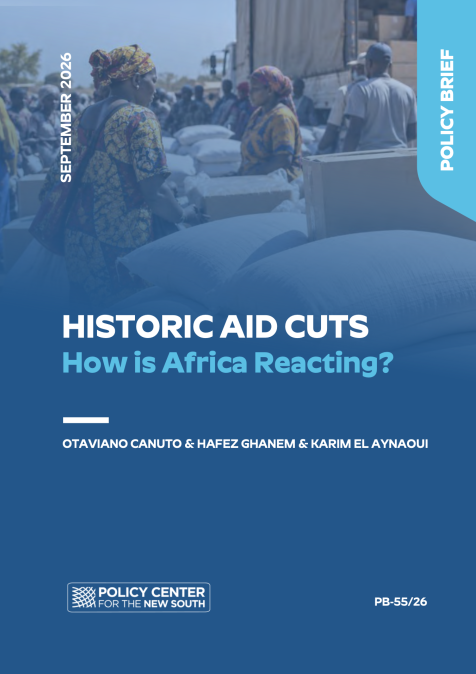
    This paper was initially published in French on the website of the Fondation Jean-Jaurès. There was a historic decline in Official Development Assistance (ODA) in 2025. Foreign aid to developing countries from members of the OECD-DAC fell by some 23%, the largest decline on record and the second consecutive annual decline. Aid to Africa fell by more than 25%. The International Monetary Fund (IMF) described this decline in ODA to Africa as “a shock like no other.” It differ ...
  • Authors
    Marianna Albuquerque
    September 23, 2026
    The author of this opinion, Marianna Albuquerque, is a 2022 alumna of the Atlantic Dialogues Emerging Leaders Program.As world leaders gather in New York for the 81st United Nations General Assembly, climate change returns to the center of multilateral diplomacy under markedly different circumstances. The debate is no longer confined to whether the world must decarbonize, but increasingly centers on how the transition will happen, who will bear its costs, who will capture ...
  • Authors
    Luladay Berhanu Mengistie
    Guillaume Gérout Suominen
    September 21, 2026
    The African Union Summit of February 2026 instructed the African Continental Free Trade Area (AfCFTA) Council of Ministers to negotiate a Protocol on Industrial Policy and Development. This work, handled without adequate preparation, is likely to reproduce the weaknesses it is meant to remedy. This paper is a conceptual mapping exercise, written to raise the preparatory questions before drafting begins, rather than to prescribe outcomes.It proceeds in five sections:1. It works towar ...
  • Authors
    Joana Ama Osei-Tutu
    September 12, 2026
    The author of this opinion, Joana Ama Osei-Tutu, is a 2017 alumna of the Atlantic Dialogues Emerging Leaders Program.South-South cooperation (SSC) is often presented as an alternative to the hierarchical relationships that have historically characterized international development. In principle, SSC means Global South countries learn from one another, share expertise and resources, and develop solutions grounded in their own experiences, rather than importing models designe ...
  • September 8, 2026
    La conférence de lancement du projet POMIRE Sud-Sud, tenue au Policy Center for the New South à Rabat les 11 et 12 février 2026, a constitué un moment fondateur. Pour la première fois, l'ensemble des acteurs institutionnels de cinq des six pays partenaires du projet — Côte d'Ivoire, Guinée, Mali, Maroc et Sénégal — se sont réunis pour poser les piliers d’une vision commune et identifier les priorités qui guideront les phases opérationnelles du projet. Quatre focus groupes thématique ...
  • August 14, 2026
    In this Episode, Arup Banerji discusses why local expertise—not just international advice—should be intentionally embedded in African development policy. He cites cash transfer programs a ...
  • Authors
    Meryam Amarir
    August 13, 2026
    Recent crises in the Middle East, particularly attacks targeting commercial vessels in the Red Sea and tensions surrounding the Strait of Hormuz, have highlighted the vulnerability of the main strategic corridors of global trade. Rather than fundamentally disrupting the organization of trade flows, these crises are accelerating an ongoing transformation driven by the search for more resilient connectivity chains, the diversification of trade routes, and the development of logistics ...