Publications /
Policy Paper

Back
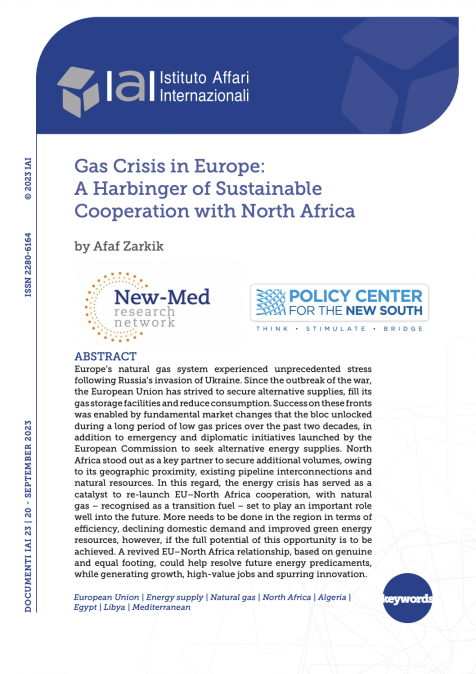
Gas Crisis in Europe: A Harbinger of Sustainable Cooperation with North Africa
Authors
September 15, 2023

This paper was originally published on iai.it

Europe’s natural gas system experienced unprecedented stress following Russia’s invasion of Ukraine. Since the outbreak of the war, the European Union has strived to secure alternative supplies, fill its gas storage facilities and reduce consumption. Success on these fronts was enabled by fundamental market changes that the bloc unlocked during a long period of low gas prices over the past two decades, in addition to emergency and diplomatic initiatives launched by the European Commission to seek alternative energy supplies. North Africa stood out as a key partner to secure additional volumes, owing to its geographic proximity, existing pipeline interconnections and natural resources. In this regard, the energy crisis has served as a catalyst to re-launch EU–North Africa cooperation, with natural gas – recognised as a transition fuel – set to play an important role well into the future. More needs to be done in the region in terms of efficiency, declining domestic demand and improved green energy resources, however, if the full potential of this opportunity is to be achieved. A revived EU–North Africa relationship, based on genuine and equal footing, could help resolve future energy predicaments, while generating growth, high-value jobs and spurring innovation.

RELATED CONTENT

  • Authors
    June 16, 2026
    Geopolitical rivalries, and especially the competition for access to critical minerals, could be an opportunity for Africa. The objective of African mineral exporters is to diversify their partners and increase processing and value addition on the continent in order to create jobs and enhance export revenues.[1] To succeed, African exporters of critical minerals need to strengthen their coordination and develop joint infrastructure projects and regional value chains. The creation of ...
  • Authors
    June 8, 2026
    The energy shock caused by the war between the United States and Israel and Iran has highlighted the need for Africa to refine more of its own crude oil. Africa is a net hydrocarbon exporter, but remains stuck in the old colonial economic model: it mostly exports raw materials and imports refined products. Africa exports about 2.6 billion barrels of crude oil every year, and imports about 1.4 billion barrels of refined products. This is a problem for two reasons. First, Africa ...
  • May 5, 2026
    Gaspillage de l’eau et son mésusage : deux facteurs du stress hydriqueCe Policy Brief est consacré aux phénomènes de gaspillage et de mésusage de l’eau: deux impératifs de la lutte contre le stress hydrique, rappelés, avec insistance, par   Sa Majesté le Roi Mohammed VI dans son discours du 29 juillet 2024, à l’occasion de la célébration du 25ème anniversaire de son accession au Trône. La première partie de l’étude aborde la problématique générale du gaspillage e ...
  • April 21, 2026
    في هذه الحلقة، نناقش الأهمية الجيو-اقتصادية للمعادن الاستراتيجية كركيزة أساسية للتحولات الطاقية والرقمية العالمية وتأثيرها المباشر على سلاسل القيمة الدولية. ونسلط الضوء على قدرة القارة الإفريقية والمغرب على تجاوز تصدير المواد الخام نحو بناء منظومة صناعية محلية متكاملة تضمن السيادة الاقت...
  • April 15, 2026
    Cet épisode explore l’industrie des phosphates au Maroc, qui abrite 70 % des réserves mondiales et est portée par le Groupe OCP. De son leadership mondial dans les engrais à un repositionnement stratégique vers l’Afrique, OCP soutient la transformation agricole et la création de valeur....
  • April 9, 2026
    Cet entretien explore le Nexus Eau-Énergie-Alimentation comme un défi systémique majeur pour le Maroc, dans un contexte de rareté croissante des ressources et de pressions sur la souveraineté. Il met en lumière les interdépendances critiques entre ces trois secteurs et les limites d’app...
  • Authors
    Fatima Ezzahra Mengoub
    February 20, 2026
    After more than seven years of drought, Morocco experienced exceptionally abundant rainfall during the winter of 2025-2026, reflecting increasingly marked water variability. This rapid alternation between chronic deficits and occasional excesses reveals the country's water paradox: a system historically centered on scarcity must now manage concentrated and intense extreme episodes.Hydraulic infrastructures helped limit human and economic impacts and ensured significant replenishment ...
  • Authors
    Fatima Ezzahra Mengoub
    February 20, 2026
    Après plus de sept années de sécheresse, le Maroc a connu durant l’hiver 2025–2026 des précipitations exceptionnellement abondantes, témoignant d’une variabilité hydrique de plus en plus marquée. Cette alternance rapide entre déficit chronique et excès ponctuels révèle le paradoxe hydrique national : un système historiquement centré sur la rareté doit désormais gérer des épisodes extrêmes concentrés et intenses.Les infrastructures hydrauliques ont limité les impacts humains et écono ...
  • November 25, 2025
    تستعرض هذه الحلقة جهود المغرب في تطوير قطاع الهيدروجين الأخضر، الذي يعد من القطاعات الواعدة لتحقيق التنمية المستدامة والطاقة النظيفة تتطرق الحلقة إلى الاستثمارات، المشاريع الاستراتيجية، السياسات الحكومية، والشراكات الدولية التي تدعم هذه المبادرة، إضافة إلى التحديات والفرص المتاحة أمام ا...