Publications /
Research Paper

Back
A Framework to Assess Services as a Driver for Economic Growth and Structural Transformation
Authors
March 12, 2026

Historically, manufacturing has served as the primary pathway to economic development, offering strong scale economies, learning-by-doing effects, and the capacity to generate the foreign exchange necessary to import capital goods and technology. However, advances in robotization and artificial intelligence (AI) are fundamentally undermining manufacturing’s traditional role, making it increasingly skill- and capital-intensive while limiting its ability to absorb labor. This technological transformation forces developing countries to consider service-led development strategies, but most services exhibit low productivity, limited tradability, and minimal capacity to generate foreign exchange. 

This paper is the first in a series to develop a methodology to identify and assess which specific services can serve as drivers for growth and structural transformation for the Global South. It proposes an analytical framework that classifies services into three categories: i) Knowledge Services (ICT and professional business services) which exhibit manufacturing-like characteristics such as tradability and foreign exchange generation capacity; ii) Enabling Services (transport, logistics, finance) which facilitate trade but generate limited independent value capture; and iii) Local Services (retail, hospitality, health, education, arts, and personal services) which absorb labor but cannot drive export-led growth. Critically, the paper addresses the education and health sectors separately, recognizing that, while they function as Local Services, they constitute essential foundational investments that enable the development of Knowledge Services. A companion paper applies this framework to assess the performance of the services sector of three North African countries: Egypt, Morocco, and Tunisia. 

To establish a benchmark against which developing countries can be assessed, we apply this framework empirically to EU15 economies over the period 2010–2022 using OECD Trade in Value Added (TiVA), Trade in Employment (TiM), and inter-country input-output tables, measuring performance across sectoral GDP and employment shares, productivity levels, external integration indicators, employment embodied in external demand, Hirschman-Rasmussen backward and forward linkages, and Leontief employment multipliers. The EU15 evidence shows that successful service-led development is not simply about expanding services in aggregate, but about shifting the internal composition of services toward Knowledge Services while maintaining efficient Enabling Services—precisely the pattern absent in countries that participate in GVCs without capturing significant value. 
RELATED CONTENT

  • July 6, 2022
    Le Policy Center for the New South et Enel Green Power Maroc co-organisent un webinaire sur "la tarification du carbone et le développement économique". Cette rencontre permettra de débattre des défis, des avantages et des limites des mécanismes de tarification du carbone et de leur imp...
  • Authors
    Inácio F. Araújo
    Fatna El Hattab
    Soulaimane Anis
    June 30, 2022
    Depuis l’année 2015, le Maroc a fait de la régionalisation avancée un choix stratégique pour concrétiser sa volonté politique de mettre en œuvre une approche de développement territorial plus intégrée. Cette initiative vise à assurer un développement territorial durable, robuste et inclusif mais aussi à capitaliser sur les potentialités de chaque région en termes de ressources. Ainsi, de nouvelles structures ont été mises en place pour moderniser les services publics et améliorer le ...
  • Authors
    June 27, 2022
    Three questions to Jamal Machrouh   This article was initially published on https://www.institutmontaigne.org/   Morocco was among the countries not taking part in the March 2 UN General Assembly vote following Russia’s invasion of Ukraine. This position raised questions in Europe as Morocco is Europe's largest partner in the Maghreb. Jamal Machrouh, Senior Fellow at the Policy Center for the New South, sheds light on Morocco's perceived neutrality in the Ukrainia ...
  • Authors
    Rishita Mehra
    June 24, 2022
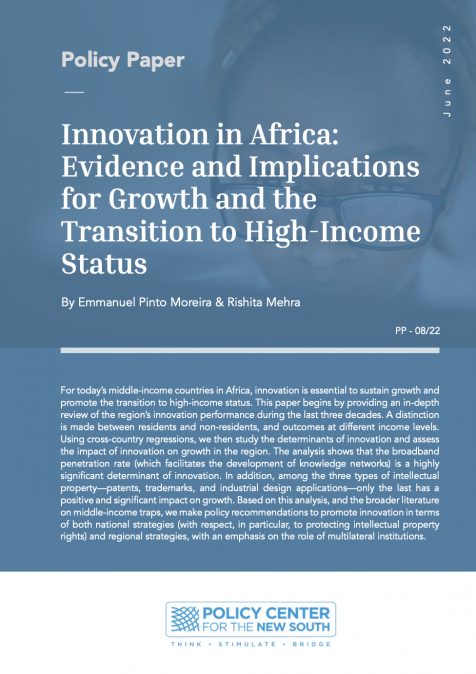
    For today’s middle-income countries in Africa, innovation is essential to sustain growth and promote the transition to high-income status. This paper begins by providing an in-depth review of the region’s innovation performance during the last three decades. A distinction is made between residents and non-residents, and outcomes at different income levels. Using cross-country regressions, we then study the determinants of innovation and assess the impact of innovation on growth in t ...
  • Authors
    Moubarack Lo
    Mohamed Ben Omar NDIAYE
    June 15, 2022
    La question de la mise en œuvre du projet de monnaie unique de la CEDEAO a encore été au centre des discussions entre les chefs d’État de la CEDEAO lors de leur 57ème session ordinaire, tenue à Niamey le 7 septembre 2020, et lors de laquelle ils ont décidé pour diverses raisons un nouveau report à une date ultérieure, après ceux de 2003, 2005, 2009 et 2015. Les chefs d’État ont aussi évoqué l’élaboration d’une « nouvelle feuille de route », sans toutefois déterminer u ...
  • June 10, 2022
    The latest IMF projections indicate that global growth will be 4.4% in 2022 after 5.9% in 2021. These projections make us very optimistic for the future, but they certainly cannot heal th ...
  • May 11, 2022
    The Policy Center for the New South is pleased to organize an online parallel event in the framework of the Annual Interdisciplinary Sovereign Debt Conference, organized by the Graduate Institute of Geneva, the European University Institute and the GeorgeTown University. The objective o...
  • May 10, 2022
    This is an exclusive interview with Rim Berahab, Senior Economist at the Policy Center for the New South, who engages with Helmut Sorge, Columnist at the Policy Center for the New South, in a conversation about the great threat of the climate crisis. Rim Berahab is the author of Chapter...