
Réforme du système multilatéral : Rapport du groupe d'experts indépendants (GEI) du G20 sur le renforcement des banques multilatérales de développement (BMD)
Président
- Suma Chakrabarti, présidente du conseil d'administration de l'ODI, Royaume-Uni
Présentateur
- N.K. Singh, président de la quinzième commission des finances de l'Inde, coprésident du groupe d'experts du G20 sur les banques multilatérales de développement (BMD)
Intervenants
- Carolina España, vice-présidente exécutive, CAF - Banque de développement d'Amérique latine
- Rebeca Grynspan, secrétaire générale, Conférence des Nations unies sur le commerce et le développement (CNUCED)
- Homi Kharas, Senior Fellow - Global Economy and Development, Center for Sustainable Development, Brookings Institution
- Donald Kaberuka, ancien président de la Banque africaine de développement (BAD)
- Vera Songwe, présidente de la Facilité de liquidité et de durabilité ; coprésidente du groupe de haut niveau sur le financement de l'action climatique
- Woochong Um, directeur général, Banque asiatique de développement (BAD)
Remarques de clôture
- Enrique Garcia, ancien président et directeur général, CAF - Banque de développement d'Amérique latine
RELATED CONTENT
-
 October 15, 2026The Policy Center for the New South, in partnership with The Asian Network, is organizing a webinar titled “Emerging Powers and the Remaking of Global Order” to examine the growing role of emerging powers and the Global South at a time of profound transformation in the international sys...
 -
October 14, 2026في ظل التوترات الجيوسياسية المتصاعدة، تتغير طرق التجارة العالمية وتتبدل معها موازين الممرات الاستراتيجية. تفتح هذه الحلقة من «حديث الثلاثاء» النقاش حول التقاء المسارات البحرية والبرية داخل هذه الممرات، والعوامل التي تتحكم في طبيعة السلع التي تعبرها. وتبحث كذلك في ما يمكن للمغرب أن يجنيه...
-
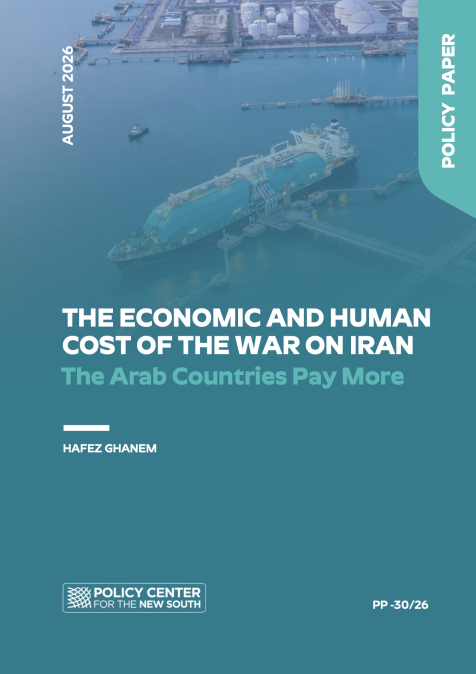 October 13, 2026“Every gun that is made, every warship launched, every rocket fired signifies in the final sense, a theft from those who hunger and are not fed, those who are cold and are not clothed.”President Dwight Eisenhower, April 16, 1953 This paper examines the economic and human impacts of the first six months of the Iran war—from February to the end of August 2026—on Iran’s Arab neighbors and compares these impacts with those on the three countries directly involved—Iran, Israel and t ...
 -
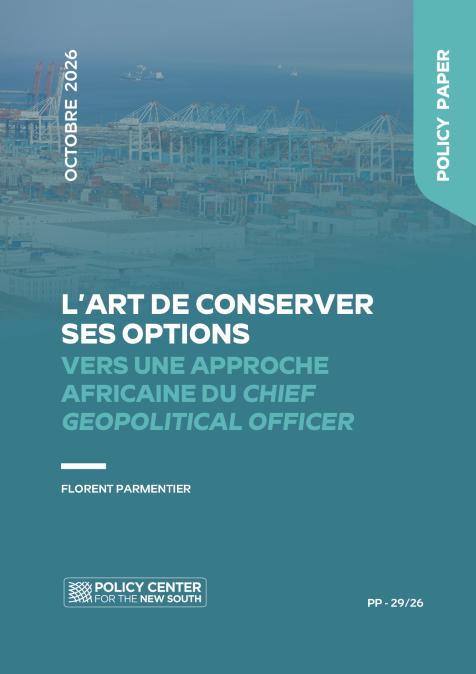 October 12, 2026Cet article soutient que le Chief Geopolitical Officer (CGO) doit être repensé à partir de l’expérience des entreprises africaines. Dans un environnement multipolaire et fragmenté, leur principal défi n’est pas seulement la gestion des risques, mais la préservation de plusieurs options stratégiques simultanément selon une logique de hedging. Trois modèles de CGO sont à distinguer : l’intermédiation (Office chérifien des Phosphates (OCP), Tanger Med), l’intégration régionale (Ethiopi ...
 -
October 9, 2026How do intra-African diasporas contribute to the continent’s development? This Africafé episode discusses their role in remittances, entrepreneurship, and skills circulation. The conversation addresses the administrative, financial, and institutional barriers that limit their contributi...
-
 October 09, 2026Can Nigeria’s Dangote refinery help strengthen Africa’s energy security amid disruptions to global supply routes? This discussion considers how expanding local refining capacity can reduc ...
 -
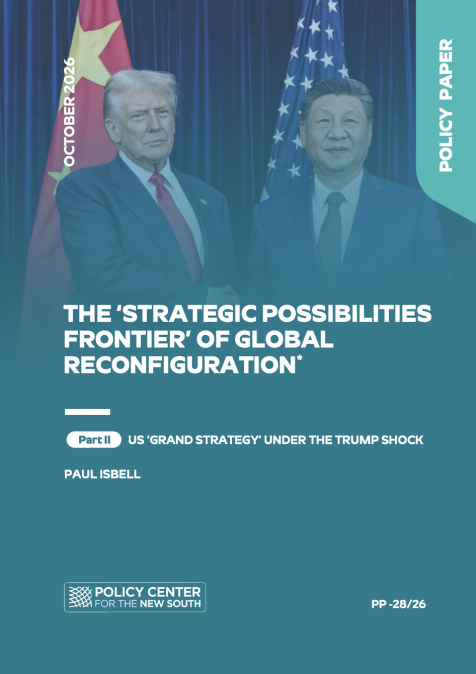 October 9, 2026In the first seven Policy Briefs of this ongoing series of analysis on Pan-Atlanticism: The Atlantic Basin in a Multipolar-Transnational World, we developed the argument that the strategic significance of the Atlantic Basin is on the rise for a range of international actors (states, regions and non-state agents) and from distinct political or ideological perspectives. In addition, in the most recently published Policy Brief -- “The U.S. and the Current International Reconfiguration: ...
 -
 October 8, 2026This paper was originaly published on Higher Education Policy Journal This article critically assesses the alignment between Morocco’s public guidance schemes for international students and its national development goals. Specifically, it investigates the capacity of these mechanisms to transform student mobility from a potential ‘brain drain’ into a tangible ‘brain gain’. Employing a qualitative case study approach, we conducted a systematic content analysis of 204 mobili ...
 -
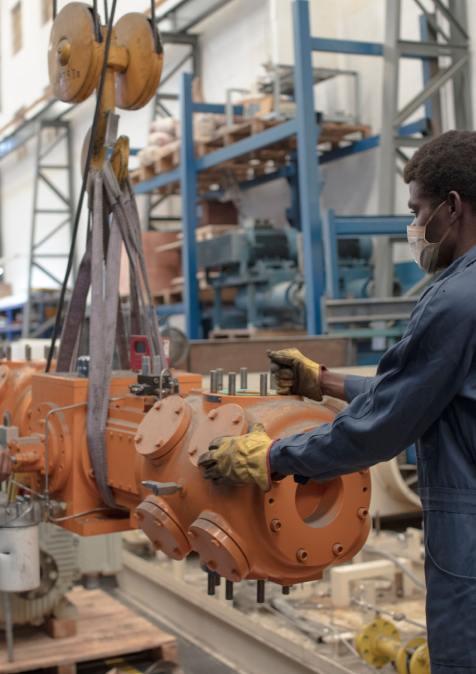 October 6, 2026The author of this opinion, Marie-Noelle Nwokolo, is a 2024 alumna of the Atlantic Dialogues Emerging Leaders Program.In September 1978, delegations from 138 countries gathered in Buenos Aires, Argentina, around a powerful idea: developing countries had knowledge, experience and capabilities worth sharing with one another. The Buenos Aires Plan of Action gave institutional form to what we now call South-South Cooperation, part of a wider post-colonial effort by developing ...
 -
 October 5, 2026This paper was originaly published on International Journal of Educational Research Open University dropout remains a major challenge in higher education due to its academic, social, and economic consequences. This study examines the role of academic and career orientation in shaping dropout in Morocco and improving student retention. A sequential mixed-methods design is applied. The quantitative component uses APOGEE administrative data covering 55,674 students and logist ...

