
Events
From Strategy to Delivery: Implementing the Mediterranean Energy Agenda – 5th Meeting of the Mediterranean Energy Experts Circle
From
To
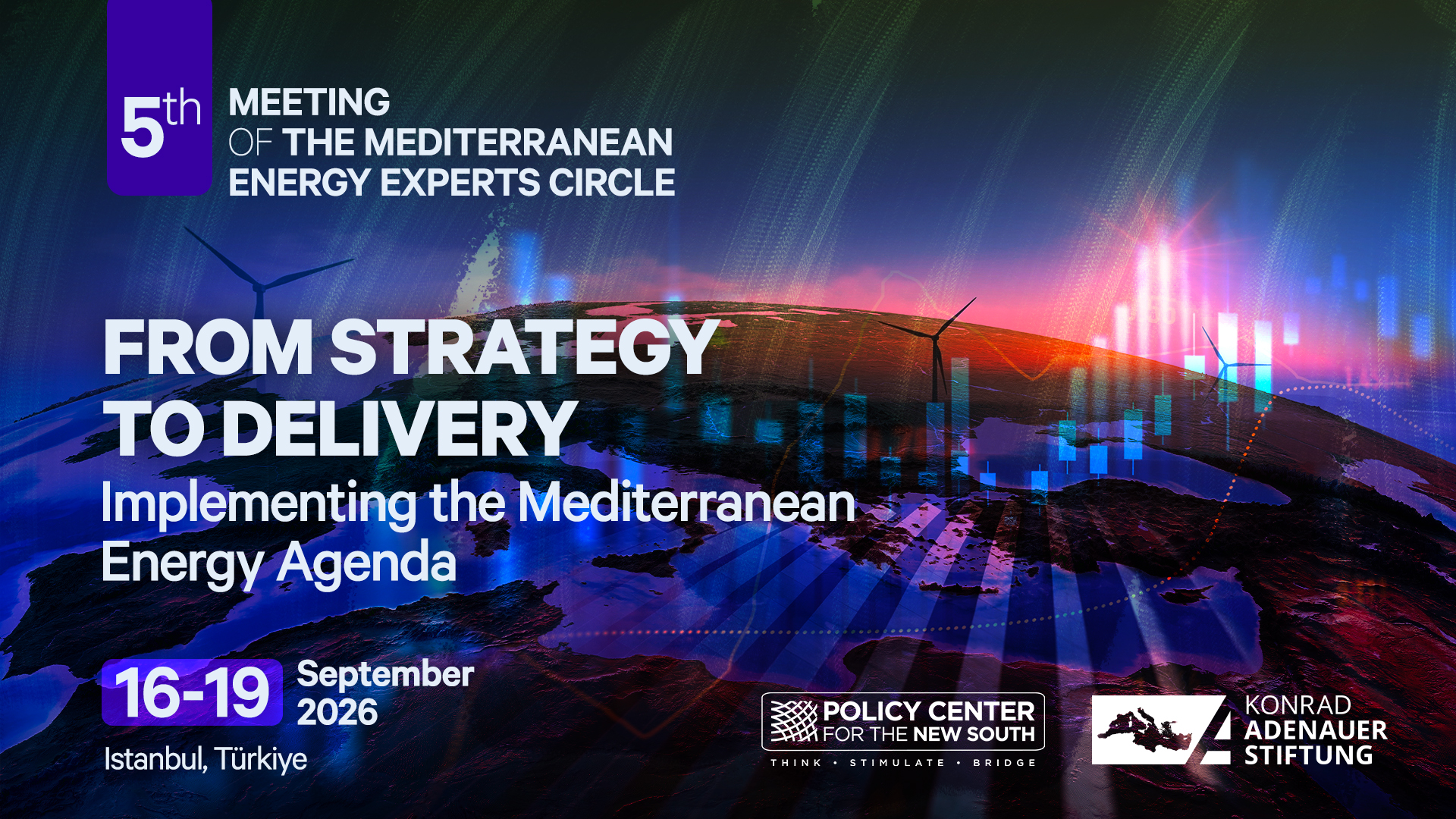
Location: Istanbul, Türkiye
The Mediterranean energy transition debate has entered a new phase: political commitments and strategic frameworks are multiplying, yet the gap between declared ambition and operational delivery remains significant. Over the past decade, the region has witnessed an unprecedented proliferation of initiatives, investment platforms, and cooperation frameworks aimed at accelerating decarbonization, strengthening interconnectivity, and enhancing energy security. From the European Union’s evolving external energy strategies to new partnership models across the Southern Mediterranean, the policy architecture takes many forms. The central question, however, is whether these frameworks are translating into concrete, bankable, and balanced outcomes across the region.
Despite abundant renewable resources, expanding market opportunities, and renewed geopolitical attention, the Mediterranean continues to face structural constraints that limit the translation of strategy into delivery. Financing gaps, risk allocation challenges, regulatory fragmentation, and uneven industrial capacities persist across the region. At the same time, global dynamics, including shifting trade regimes, renewed focus on energy security, the resurgence of natural gas markets, and intensifying technological competition, are reshaping the incentives and constraints facing Mediterranean countries. The risk of a two-speed transition remains real: while parts of Europe accelerate toward ambitious decarbonization targets, several Southern Mediterranean economies must balance fiscal stability, industrial competitiveness, and energy access within tighter financial and institutional margins.
In this evolving context, the challenge for the Mediterranean is beyond scaling renewable and infrastructure development, and increasingly about ensuring that emerging frameworks (such as the Pact for the Mediterranean and the Global Gateway strategy) translate into bankable projects, industrial value creation, and credible regulatory convergence. At stake is the region’s ability to position itself as an integrated and co-owned energy space capable of supporting long-term economic resilience.
This edition also convenes against the backdrop of the escalation triggered by the 28 February 2026 US-Israel strikes on Iran and Iran's retaliatory closure of the Strait of Hormuz. According to the International Energy Agency, oil and refined-product flows through the strait fell to under 10% of pre-crisis levels at the height of the disruption, a chokepoint that in ordinary times carries close to a fifth of global oil consumption, or roughly 20 million barrels per day. Beyond the immediate volatility in prices, freight, and insurance costs, the crisis is prompting states, investors, and operators to revisit long-standing choices on infrastructure, suppliers, and investment criteria, with resilience and redundancy re-emerging as considerations alongside cost.
Three directions appear to be emerging: a renewed premium on infrastructure that bypasses vulnerable chokepoints (alternative pipelines, ports, and storage); a stronger strategic rationale for sourcing energy closer to consumption markets, which increases the relative weight of North Africa and the Southern Mediterranean given their renewable resources, existing gas connections, and Mediterranean and Atlantic façades; and a gradual complementing of maritime hydrocarbon flows with electricity interconnections, renewables, storage, and, over the longer term, hydrogen. The effect on the pace of decarbonization itself is more ambiguous. The crisis strengthens the economic and geopolitical case for domestic renewables, illustrated by the EU's June 2026 T-MED initiative, which targets up to €25 billion in Southern Mediterranean renewable and clean-tech investment by 2035; while also raising financing costs and risk premia, and tempting governments toward emergency responses (fuel subsidies, gas purchases, strategic stockpiling) that can crowd out longer-horizon transition spending. This meeting takes stock of how these dynamics are reshaping the strategic calculus for Mediterranean energy cooperation.
Against this backdrop, the Konrad Adenauer Stiftung Regional Program Political Dialogue South Mediterranean (KAS PolDiMed) and the Policy Center for the New South (PCNS) are convening leading experts from across the region for the 5th meeting of the Mediterranean Energy Experts Circle. This edition shifts the focus from diagnosis to delivery. It aims to critically assess implementation progress, identify persistent bottlenecks, and foster a structured dialogue on pragmatic pathways to strengthen bankable partnerships, regulatory alignment, and strategic coordination across both shores of the Mediterranean
Strategic Objectives for the Meeting:
Assess the extent to which recent regional and EU-led energy transition frameworks are translating into concrete, implementable, and financially viable projects across the Mediterranean.
Identify structural bottlenecks (financial, regulatory, institutional, and geopolitical) that continue to hinder cross-border energy cooperation and infrastructure development.
Examine the evolving role of natural gas and other transitional dynamics in shaping fiscal stability, industrial strategy, and long-term decarbonization pathways in the region.
Advance practical recommendations to strengthen bankable partnerships, improve risk-sharing mechanisms, and promote greater regulatory and governance convergence between Northern and Southern Mediterranean countries.
Draw out the implications of the 2026 US–Israel–Iran conflict for energy security and the energy transition across the Mediterranean, including infrastructure priorities, corridor and port strategies, and the relative pace of renewable investment across the region.

