
Events
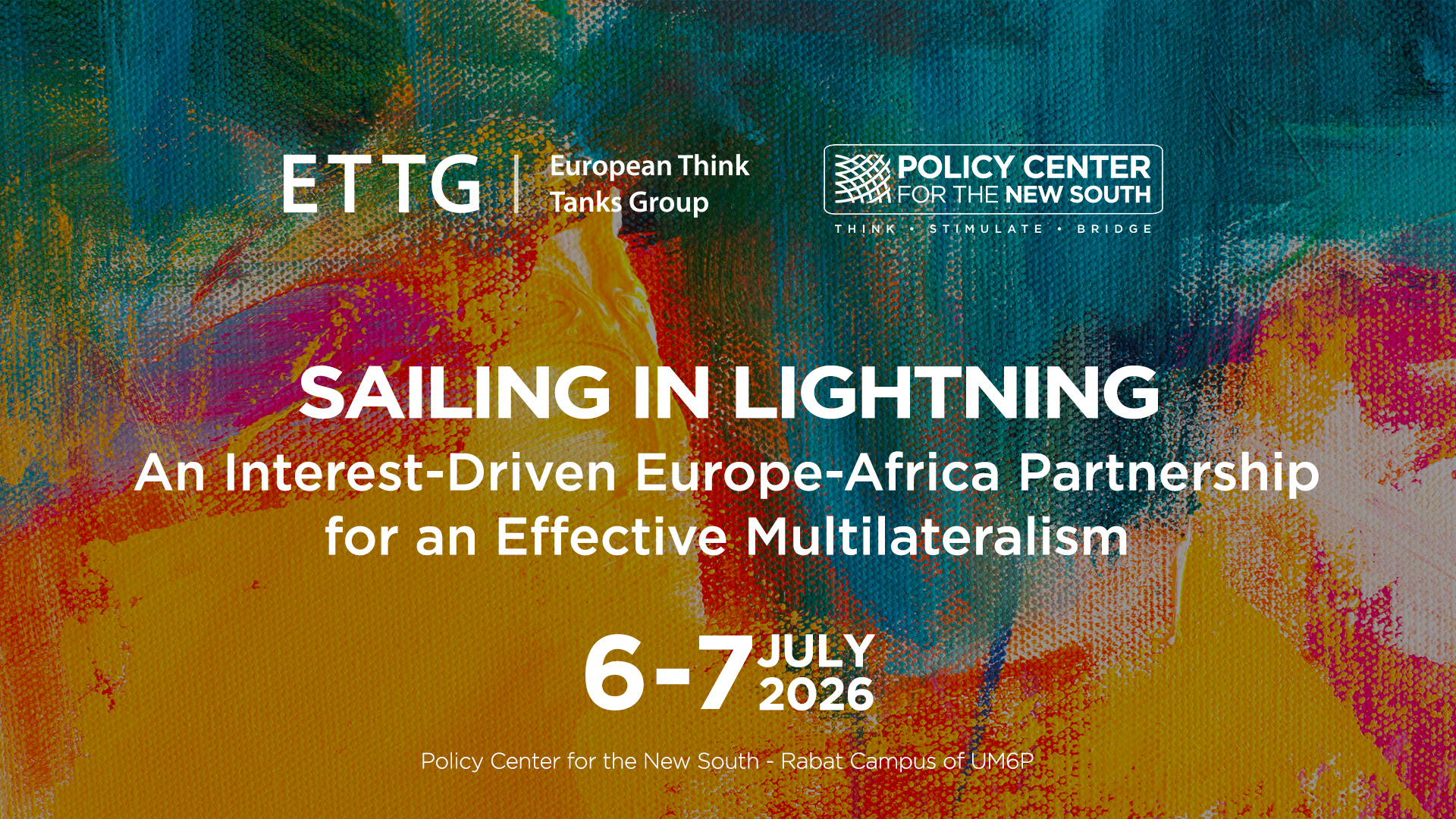
Sailing in lightning: An interest-driven Europe-Africa Partnership for an Effective Multilateralism
From
To
By Invitation
In 2023, the members of the European Think Tanks Group (ETTG) launched a multi-year partnership with the Open Society Foundations titled Towards a more interest driven and equal EU-Africa Partnership. The partnership has aimed to contribute to a renewed, forward-looking cooperation between Europe and Africa, focusing on mutual interests and equal footing, by generating policy-relevant research and fostering dialogue across regions. It has analyzed areas of disagreement and identified opportunities for collaborations on the six areas of climate finance, digitalization, green industrialization, migration and security
This collective effort has mobilized researchers and analysts from seven European think tanks (ECDPM, the Elcano Royal Institute, the Istituto Affari Internazionali, the Institute for Sustainable Development and International Relations, the German Institute of Development and Sustainability, the Nordic Africa Institute, and ODI Global), as well as 6 African research organizations (the African Centre for Technology Studies, the Center for Democratic Development - CDD Ghana, the Gorée Institute, the Nelson Mandela University, the Policy Center for the New South and the South Africa Center for Human Rights). To date, it has also gathered more than 250 participants representing African and European administrations and parliaments, think tanks, academia, civil society organizations and the business sector in eight different workshops, held between 2023 and 2025. As a result, the project has benefited from interdisciplinary perspectives and cross-regional expertise, ensuring that its output reflects a broad range of views and experiences.
Through a series of policy briefs, workshops, and stakeholder engagements, the project has sought to inform policy debates and provide actionable recommendations for policymakers on both continents.
Since the project was originally designed in 2022 and 2023, the global context has changed dramatically. The protracted war in Ukraine has continued to reshape geopolitical priorities and resource allocations. Institutional changes within the European Union, including a new European Parliament and Commission, are redefining external engagement strategies. The return of a Trump administration in the United States has contributed to deeper international fragmentation, escalating trade tensions, and renewing instability, including a worsening of conflicts in the Middle East. At the same time, international institutions and agendas have kept on evolving, with relevant trends – such as the end of the aid system as we knew or the consolidation of Global South political spaces – and milestones – the 4th International Conference on Financing for Development (FfD4) and the 7th AU-EU Summit are only two examples.
While the project has made efforts to remain responsive to these rapid and far-reaching changes, some emerging issues and perspectives have inevitably remained underexplored. This moment therefore offers a timely opportunity to reflect on the project's findings, reassess priorities, and identify future avenues for EU-Africa cooperation in an increasingly complex global environment.
Against this backdrop, the European Think Tanks Group and the Policy Center for the New South are co-convening a joint event whose aim is, on the one hand, to take stock of the work undertaken under this project, synthesizing key findings and identifying future avenues for collaboration across the core thematic areas of climate finance, digitalization, green industrialization, migration and security. On the other hand, we will engage in a focused conversation on pressing issues in the global development and international and bi-regional policy agenda, with particular attention to (1) critical raw materials and their geopolitical, economic, and environmental implications; (2) the future of multilateralism and global governance in a context of increasing fragmentation; (3) the changing landscape of (in)security challenges.
Agenda
| Monday, July 6, 2026 | |
| 18:00 – 18:05 | Master of Ceremony Sabrine Emran, Senior Economist, Policy Center for the New South |
| 18:05 – 18:20 | Introductory Remarks Karim El Aynaoui, Executive President, Policy Center for the New South Iliana Olivié, Director, European Think Tank Group |
| 18:20 – 19:30 | Panel Discussion The New Geometry of Power: Reimagining Global Governance for a Multi-Polar Era Moderator Speakers |
| 19:30 – 21:00 | Networking Reception |
| Tuesday, July 7, 2026 | |
| 08:30 – 09:00 | Welcome Coffee |
| 09:00 – 09:15 | Setting the Scene Sabrine Emran, Senior Economist, Policy Center for the New South |
| 09:15 – 10:45 | Session I Matching climate transition with green industrialization needs Moderator Speakers |
| 10:45 – 11:15 | Coffee Break |
| 11:15 – 12:45 | Session II Mobility and Skills for the Future Moderator Speakers |
| 12:45 – 14:00 | Lunch Break |
| 14:00 – 15:30 | Session III Strengthening Europe-Africa Security Architecture Moderator Speakers |
| 15:30 – 16:00 | Coffee Break |
| 16:00 – 17:30 | Session IV Leveraging Critical Minerals for Mutual Growth Moderator Speakers |
| 17:30 – 17:45 | Closing Remarks Iliana Olivié, Director, European Think Tank Group Nouzha Chekrouni, Senior Fellow, Policy Center for the New South |

