
Events
On Think Tanks (OTT) Annual Conference 2026
From
To
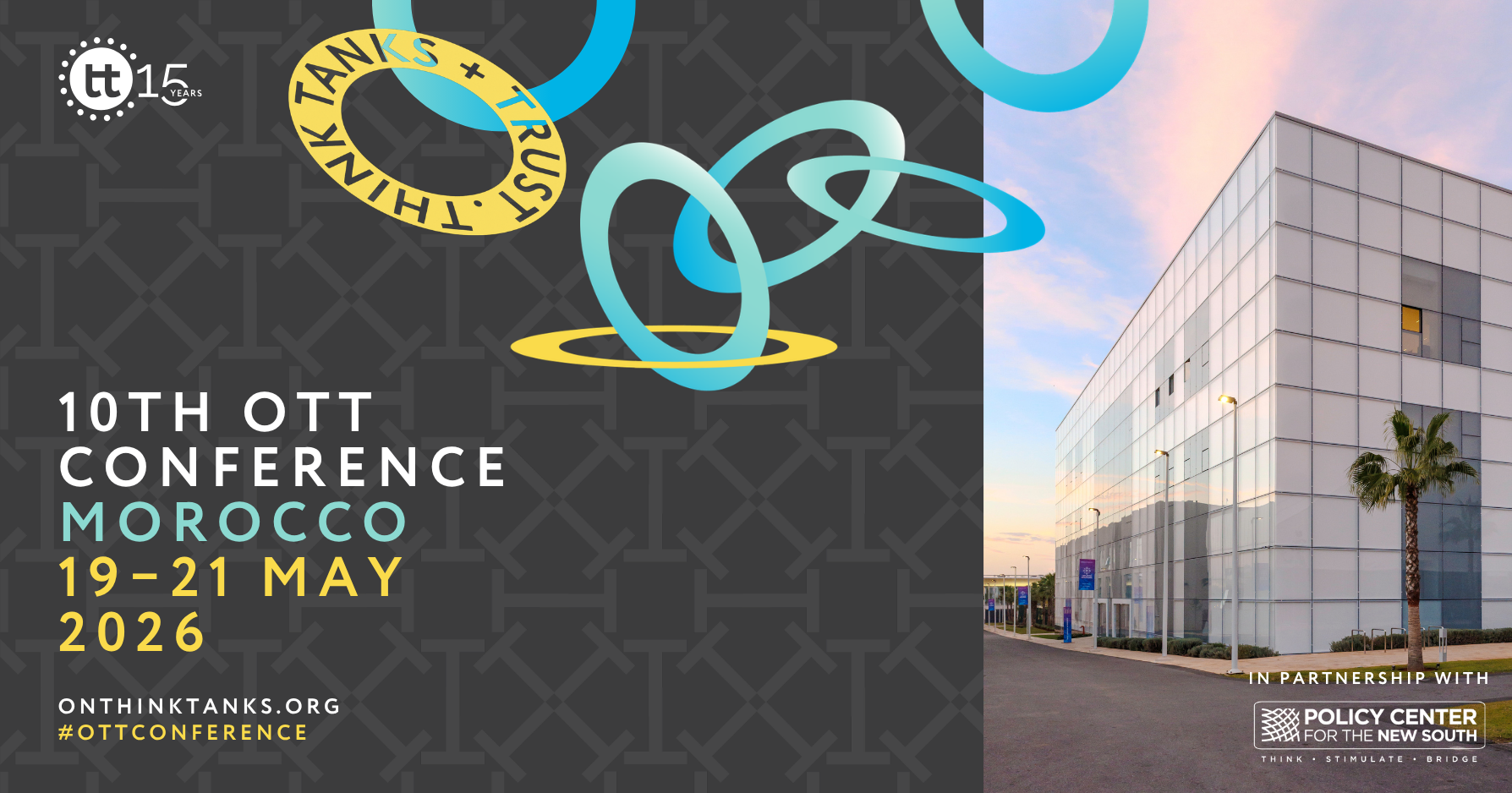
The On Think Tanks (OTT) Conference is a global gathering of think tank professionals, funders, and policy experts dedicated to exchanging knowledge, building meaningful partnerships, and collaboratively addressing shared challenges in the policy research and advocacy sector.
The 2026 edition of the conference will be held in partnership with the Policy Center for the New South (PCNS) from May 19 to 21, 2026, at the PCNS headquarters in Rabat, Morocco.
For further information, please visit the website: https://onthinktanks.org/conference/ott-conference-2026/
Agenda
Wednesday, May 20, 2026 | |
| 09:00 – 09:30 | Registration and welcome coffee |
| 09:30 – 10:00 | Introductory remarks Karim El Aynaoui, Executive President, Policy Center for the New South |
| 10:00 – 10:30 | Keynote 1: The Knowledge in This Room Erica Schoder, Executive Director of the R Street Institute AI can now produce a competent policy brief. So if anyone can produce the output, what is a think tank actually for? In this keynote, Erica Schoder argues that think tanks have always produced two kinds of knowledge: the analytical work AI now does well, and constituted knowledge that only comes into being when people with real stakes work through hard problems together. Drawing on her research at Edinburgh Futures Institute and fourteen years leading R Street Institute, she offers a practical framework for identifying where your institution's constituted knowledge gets produced and making it visible to stakeholders and funders. |
| 10:30 – 11:00 | Coffee break |
| 11:00 – 12:30 | Parallel sessions Parallel session 1A: Stop Complaining About the Trust Deficit Margarita Beneke De Sanfeliu, Director, Center for Research and Statistics, FUSADES Trust isn’t abstract or accidental; it is built through identifiable organizational mechanisms. This session introduces a research-based analytical framework and Theory of Change (ToC) for building trust — not policy influence — drawing on new research on civil society organizations. Using four core mechanisms: Accountability, Legitimacy, Connection, and Independence — participants will examine common trust gaps in think tank operations, share real-world examples of what works (and what doesn’t), and identify practical intervention points within their own organizations. Moving from principle to practice, the session will culminate in a co-created draft Theory of Change or common framework to help think tanks design a more systematic path toward credibility and sustained trust. Parallel session 1B: Building a trusted think tank brand Annapoorna Ravichander, Consultant, On Think Tanks In an AI-shaped information ecosystem, think tanks can’t assume trust—they have to earn it. This interactive session explores how a clear narrative, purposeful positioning, and sustained strategic communications help think tanks build credibility with different audiences who are looking for different “signals” of trust (and sometimes demanding incompatible things). Soapbox—one of the world's leading design, digital and communications agencies for think tanks—will open with a practical framework on trusted brands: whose trust matters, why, and what it takes to gain it. Then the room breaks into a set of mini “comms agencies” (teams of 5–6). ISS and Annapoorna Ravichander will each present a real-world brand challenge and share a written brief. Teams will rapidly develop and pitch audience-first responses—moving beyond “communicating research” towards building trust in the organisation, its experts, its ideas, and the value it offers. The strongest pitch wins a prize—and everyone leaves with tools and ideas to apply immediately. Parallel session 1C: The Currency of Credibility: Building Trust to Secure Unrestricted and Less-Restricted Funds Judith Katz, Director of Advancement, Center for Law, Energy and the Environment (CLEE), UC Berkeley Law Think tanks globally are facing increasing financial challenges, particularly when it comes to raising core funding to bridge the gap of indirect costs. Many think tank leaders experience anxiety because of a perceived choice between strident case-making for the organization’s continued existence, or adjusting research portfolios to match funder interests. “The Currency of Credibility” is about moving beyond this binary by offering a few widely applicable baseline frameworks, skills, and case studies for trust-building and relationship-based fundraising. It is geared towards think tank leaders with small or nascent fundraising operations and will provide a few takeaways that can be applied in universal contexts. Parallel session 1D: The Inside Job: Organizational Culture as a Strategic Asset for Think Tanks Emma Woodford, COO, European Policy Centre Think tanks invest heavily in external credibility — research quality, policy influence, communications — yet far less attention is paid to what happens inside: leadership practices, staff management, lived values, and whether the organization is one people stay committed to when pressure mounts. In a context of shrinking funding, authoritarian backsliding, and shifting workplace expectations, organizational culture has become a resilience issue rather than a soft concern. This 90-minute workshop brings together practitioners from contrasting contexts — including a government-affiliated research institute, and the Brussels-based European Policy Centre — to examine real experiences in people management and culture. Participants will explore shared internal challenges, from attracting and retaining talent to navigating conflict and change management, and work through practical questions about the competences needed to build inclusive, adaptive organizations in uncertain or hostile external environments. Parallel session 1E: The Future of Think Tanks Starts Now! Carlos Alvarez Pereira, Secretary General, The Club of Rome When knowledge is cheap, information is frictionless, and evidence is easily available to everyone. What is the value of think tanks? What is left for them to do? This is a hands-on workshop for those grappling with the questions of the future and the practicalities of running a think tank under new conditions. We'll explore what think tanks do better than anyone else, how to communicate that value to policymakers and funders, and what that means for our impact and influence. |
| 12:30 – 13:30 | Building a stronger community sessions Session 1: Unlocking Global Impact for Southern Think Tanks Beatriz Pfeifer, Network Engagement Officer, Southern Voice This session will explore the critical importance of Global South think tanks engaging in global policy, which directly influences national agendas. Participants will discuss key constraints preventing this prioritization and provide input to help funders align their support for global-focused work. Guiding questions will include:
Session 2: Understanding Chinese think tanks: An opportunity for collaboration Fei Chen, PhD Candidate, School of Information Management, Nanjing University Chinese think tanks are growing in number and sophistication. Still, little is known about them outside of China or specialized foreign policy circles. In this session, delegates from Nanjing University and the Chinese Academy of Sciences will provide an overview of the Chinese think tank sector, Chinese think tanks’ main strategies and current developments in the sector. The presentation will also outline opportunities for collaboration with Chinese think tanks. The ask: How could Chinese think tanks better collaborate with their peers in other regions? Session 3: Measuring impact: one year on Kareem Makhlouf, Chief of Staff, New Lines Institute for Strategy and Policy New Lines Institute upgraded its impact model and rolled it out last year. Some of the thinking was shaped by conversations at the OTT Conference last year, and some of it was their own. They'd love to open up a conversation about whether any participants changed their approach to MEL, and what they did differently. They'd be happy to share what they did differently on the day, and some of the challenges they found, to kick off the conversation. The ask:
Session 4: Knowledge Creation in the Age of AI: Introducing sIfA as a way to foster a culture of transparency towards knowledge equity Mareike Schomerus, Vice President Voice & Impact, Busara AI is rapidly changing knowledge creation, yet we currently lack an accurate record of its impact on our collective knowledge. A significant barrier to understanding this transition is the culture of secrecy within many think tanks regarding how AI is used. In this session, Busara will introduce the sIfA—an open-access tool developed to tackle this challenge by fostering transparency. The session aims to encourage collective learning on how AI is shaping the sector and to identify the best ways to support diverse, inclusive and equitable knowledge production. The ask:
|
| 13:30 – 15:00 | Lunch |
| 15:00 – 15:30 | Unpopular opinions: Singalong A sing-along to share and present "un-popular" opinions. Bring your own and do not be afraid to share them. |
| 15:30 – 16:00 | Keynote 2: Trusted by Whom? Rethinking Think Tank Legitimacy in the African Context Denis Foretia, Co-Chair, Denis & Lenora Foretia Foundation & Executive Chairman, Nkafu Policy Institute Who do think tanks truly serve, and whose trust do they seek to earn? This keynote challenges traditional notions of legitimacy by examining the competing expectations of governments, funders, and citizens in African policy spaces. Drawing from Nkafu's experience, it calls for a shift toward more locally grounded, accountable, and responsive institutions, and reframes trust as something that must be actively earned, negotiated, and sustained. |
| 16:00 – 16:30 | Coffee break |
| 16:30 – 18:00 | Parallel sessions Parallel session 2A: Trust Among Think Tanks Salim Kombo, Engagement Director, BUSARA Networks and collective action are often seen as pathways to systems change, yet many think tank networks struggle to move beyond early enthusiasm or donor-funded beginnings. Misaligned expectations, limited resources, and underlying competition frequently undermine their long-term sustainability. This session takes a behavioral and systems-thinking lens to examine what makes networks truly effective, and what causes them to falter. Drawing on participant experience, it will explore practical strategies for building and sustaining collaboration at local, regional, and global levels, balancing cooperation with competition, and designing the formal and informal rules that enable policy research networks to endure. Parallel session 2B: Universities and Think Tanks: Strategic Alliances for Knowledge, Impact, and Sustainability Karim El Aynaoui, Executive President, Policy Center for the New South Think tanks and universities are facing parallel pressures: think tanks must diversify funding and demonstrate policy relevance, while universities are pushed to show real-world impact beyond academia. This session explores whether deeper collaboration — particularly through university-based think tanks — offers a credible and sustainable path forward. Drawing on different institutional models, from academically anchored research centers to more autonomous hybrid structures, the discussion will examine the benefits and trade-offs of these partnerships. Participants will consider how universities can contribute credibility, intellectual diversity, and relative funding stability, while think tanks bring agility, policy relevance, and knowledge translation, alongside the tensions these collaborations create around autonomy, governance, and responsiveness. The session aims to identify practical models that balance excellence, relevance, sustainability, and trust in policy research. Parallel session 2C: Mobilizing Domestic Funding: What Think Tanks Can Do Joy Chatterjee, Senior Associate and Team Lead, OTT Across low- and middle-income countries, think tanks consistently report that domestic funding cannot yet replace shrinking foreign aid. While this challenge is real, this session shifts the focus from diagnosis to action. If think tanks are trusted actors in shaping policy frameworks that unlock investment and enable tax reform, why not apply that same policy expertise to the funding of policy research itself? Drawing on a joint review by WINGS and OTT of case studies where policy change has helped mobilize domestic philanthropy, the session will explore how national frameworks can incentivize local giving, corporate social responsibility, and impact investing. Participants will share additional examples and consider how similar reforms can be advanced in their own contexts to strengthen long-term financial sustainability for think tanks. Parallel session 2D: Trust in others: collaboration with governments, funders, academia, and implementers Catherine McCarron, Business Development Associate, C4ADS Change requires multiple sectors to work toward the same objectives. But how often do NGOs, corporations, governments, social movements, political parties and others come together and cooperate? Can think tanks leverage these diverse sectors’ expertise and ability to take action? In this session, we will examine how think tanks can build trust across and between sectors, proposing strategic communication and bridge building as a solution to this challenge. Participants will co-create a collection of ideas, examining how: (1) think tank analysis can be communicated across different audiences without compromising rigour and independence, and (2) think tanks can promote strategic cross-sector communication and collaboration. Together, let us consider how we can redefine think tanks – not just as centers for thought, but as bodies working to unite diverse actors for change. Parallel session 2E: Your Research Is Good, But Does Anyone Know That? Building a Trust Infrastructure for Think Tanks Nick Cleveland-Stout, Research Associate, Quincy Institute Many think tanks produce rigorous research, but it can be difficult to know which to trust. This leads policymakers and AI systems to favor established think tanks, leaving smaller or less visible organizations struggling for attention despite producing high-quality work. In this workshop we'll share two perspectives on what a trust infrastructure for think tanks — one that could level the playing field — might look like, from funding transparency to content trust marks. Join us, we'd like to hear what you think about trust too. |
| 18:00 – 18:30 | Final roundup Come together to reflect on the day's discussions |
| 20:00 – 22:00 | Screw-up Night – Venue: Le Bistrot du Pietri Goran Buldioski, Senior Advisor, OTT Join Conference participants to share stories of failures, learn from them and have a laugh. |
Thursday, May 21, 2026 | |
| 09:00 – 09:30 | Registration and welcome coffee |
| 09:30 – 10:00 | Introductory remarks Reflect on the lessons learned and the contacts made on Day 1 |
| 10:00 – 10:30 | Keynote 3: Do think tanks matter? Rosa Balfour, Director, Carnegie Europe Sweeping global changes are upending international and domestic politics, fostering new patterns of ideological politicization and challenging open societies. Artificial Intelligence and a contested information ecosystem are ushering in a revolution in how people relate to knowledge. Security imperatives are looming large over public and private budgets, reshaping the priorities of independent research. In the face of unpredictable turmoil and declining trust in expertise, asking whether think tanks matter is not a rhetorical question. The talk will explore the challenges to think tanks and make a case for their relevance. |
| 10:30 – 11:00 | Coffee break |
| 11:00 – 12:30 | Parallel sessions Parallel session 3A: Regional think tanks - opportunities and challenges Chibuikem Agbaegbu, Senior Fellow, Head of Climate Transitions Program, Africa Policy Research Institute (APRI) This session will explore the unique challenges and opportunities faced by think tanks attempting to work and influence policy at the regional level. The session will explore how think tanks define their audiences and objectives, the research and communication strategies that make the most sense to them and the competencies and skills they need to develop to operate at the regional level. Parallel session 3B: Forget core funding: alternative income streams for resilient think tanks Liliana Alvarado, General Director, Ethos Innovación en Políticas Públicas While core funding remains the benchmark for institutional stability, today’s competitive and constrained funding landscape makes it increasingly difficult to secure. This session explores how think tanks can strengthen financial resilience by moving beyond traditional grants and developing alternative income streams that can work alongside a think tank's autonomy, credibility, and long-term relevance — particularly in politically complex democracies. Drawing on concrete examples and emerging models, participants will examine options such as membership programs, public opinion polling services, consulting, event sponsorships, and training activities, with a focus on designing and managing these revenue streams without compromising independence or mission integrity. Parallel session 3C: Funder restrictions and how to work around them Fiorella Bianchi, Director of Finance and Strategy, OTT Consulting Understanding funder conditions is essential for sustainable budgeting, financial planning, and long-term strategy. To support this, OTT has been developing a shared, community-led resource that maps the conditions funders apply to think tanks — across funding models, contracting, budgeting, and reporting. Yet transparency alone is not enough. This session moves from information to action, inviting participants to share and discuss practical strategies for navigating funder restrictions, designing smarter project budgets, and strengthening organizational resilience in the process. Parallel session 3D: Can AI Become Trust Infrastructure? Noel Gruber, Director, Communications & Public Affairs, Centre for International Governance Innovation (CIGI) Think tanks exist to produce credible, independent knowledge. But in a world where trust is eroding, and AI is accelerating that erosion, the question is no longer whether to engage with AI, but how to do it without compromising what makes you credible in the first place. In this hands-on workshop, we'll move beyond the debate and into the design. We will prototype AI agents tailored to think tank operations, stress-test them against real governance and trust criteria, and leave with concrete ideas we can actually take back to our organizations. |
| 12:30 – 13:30 | Building a stronger community sessions Session 5: How do we build, sustain and fund cross-regional collaboration Jennifer Hecht, Project Manager, Stiftung Mercator Anyone who has wrestled with the challenge of working (and funding work) across borders, across sectors, or across the upstream-downstream divide on sustainability issues – or any issue; and who is ready to be honest about what has worked, what has not, and what it would take to do better, should join this session. Ingmar Juergens, co-founder of Climate & Company, is struggling with these challenges. But he sees a significant opportunity to mobilise private funding – if only think tanks found better ways to collaborate. The asks:
Session 6: Opportunity – the Partnership for Economic Policy (PEP) Jane Mariara, Executive Director, Partnership for Economic Policy Learn about the Partnership for Economic Policy (PEP) and its role facilitating locally-led economic analysis and policy advice. This session, led by Jane Mariara, Executive Director, will offer participants the opportunity to learn how PEP works with research centers and think tanks to develop their research and policy engagement competencies and skills. Jane will present PEP’s approach and services for think tanks and explain how Conference participants can benefit from them. The ask:
Session 7: University - Think Tank Partnerships and building mutually beneficial opportunities for students, faculty and think tanks Donna Tonini, Associate Director, Center for Global Studies, University of Illinois The University of Illinois, Urbana-Champaign has a new Master's of Science in Global Studies, which has 3 tracks focusing on global governance, global security, and gender and public policy. All 3 tracks combine theory with policy and practice, as the degree prepares students for professional careers in think tanks, non-profits, domestic or international governments, and the private sector. Their specific challenge is how to efficiently and effectively work with think tanks to develop internship opportunities that benefit their students, faculty, and the hosting think tanks. They would also like to know if any think tanks in the community are interested in exploring possible partnerships! Session 8: US-Bangladesh NextGen Fellowship and Policy Institute Atif Ahmed Choudhury, Founder and CEO, US-Bangladesh NextGen Policy Fellowship The U.S.–Bangladesh NextGen Fellowship and Policy Institute is developing a hybrid model that combines policy research and public engagement with scholarships, mentorship and fellowship opportunities for students interested in Bangladesh and South Asia. As a newly launched organization, USBNFPI seeks practical advice on how emerging think tanks can fund and manage this kind of work to achieve several objectives, including:
The conversation will be relevant to other emerging organisations exploring how to combine policy engagement, youth development, community-building and public-facing research in a challenging funding environment. |
| 13:30 – 15:00 | Lunch |
| 15:00 – 15:30 | What is new and newsworthy? After almost 2 days of community building this is a great time to share what is new and newsworthy in the community. A moment to call out the good ideas and practice we have learned about. Keep an eye out for nominations to the 2026 100 Think Tanks to Watch list! |
| 15:30 – 16:00 | Keynote 4: If We Don’t Tell the Story, Others Will: Think Tanks in a Polarized World Héctor Cárdenas, President at the Consejo Mexicano de Asuntos Internacionales (COMEXI) In an age of polarization, information overload, and declining trust, think tanks face a fundamental challenge: evidence alone no longer shapes policy. Influence increasingly depends on the ability to frame issues, shape narratives, and engage strategically in contested debates. Drawing on examples from Mexico, North America, Europe, and the global development community, this keynote explores how think tanks can evolve from knowledge producers into true strategic actors. It examines why strong evidence often fails, how compelling narratives redefine fields, and what it takes to tell stories that are both persuasive and grounded in fact—so that ideas do not just exist, but matter. |
| 16:00 – 16:30 | Coffee break |
| 16:30 – 18:00 | Parallel sessions Parallel session 4A: T7 and T20: Lessons for greater global think tank cooperation Abdelaaziz Ait Ali, Head of Research in Economics, Policy Center for the New South This session distils practical lessons from how the T20 and T7 have been organized by focusing on what has made these processes work: how hosts structure task forces, coordinate diverse institutions, manage comms between participants, and hand over knowledge year-to-year to the next hosts. Participants will map the elements that could be copied, adapted, or avoided in future editions. The session will offer future T7 and T20 hosts and participants a shortlist of design choices (governance, rhythm, outputs, convening formats) that strengthen coordination and trust between think tanks, enhance the credibility of the think tank body, and drive real-world uptake and impact of their proposals. Parallel session 4B: The role of student-led think tanks: education, impact, and professionalization Elizaveta Barabanova, President, European Student Think Tank Student-led think tanks play an important role in shaping the next generation of policy professionals, offering a space for peers to engage with complex issues while building research, leadership, and policy engagement skills. Yet they face distinct challenges — high turnover, limited institutional memory, and the need to balance academic commitments with organizational responsibilities — which can affect continuity, research quality, and long-term strategy. This session explores how student-led think tanks can strengthen their impact and sustainability through more structured organizational models and innovative forms of collaboration. Drawing on approaches such as hybrid and dual-entity models, as well as peer-to-peer engagement strategies, participants will examine how these organizations can be adapted across contexts and how stronger links with established think tanks can support their growth and long-term relevance. Parallel session 4C: 2026 State of the Sector Report: Hacking the data Wessam El Beih, Regional Director for Middle East and North Africa, IDRC The State of the Sector Report survey gathers insights from hundreds of think tanks worldwide. In 2026, OTT will invite Conference participants to engage directly with the latest data and emerging findings to help shape the final report. This participatory session will focus on prioritizing key trends, assessing their relevance across regional and national contexts, and co-developing explanations and implications for think tanks and their supporters — turning sector-wide data into shared analysis and practical insight. Parallel session 4D: From Trust Gap to Trust Infrastructure: The Role of Think Tanks in Rebuilding Institutional Confidence Lobna Jeribi, Board Member, African Climate Foundation Across regions, public trust in institutions is under strain, shaped by misinformation, weak transparency, and limited accountability, with different implications across contexts. In this environment, think tanks and research organizations can play a role beyond analysis — helping create the conditions for trust through shared understanding, credible data, transparent processes, and spaces for collaboration. This session explores how trust is built in practice, starting with a case study on how data can support alignment and collective action, and expanding to other “trust drivers” such as strategic communication, accountability, and inclusive participation. Participants will identify the levers most relevant to their contexts and work together to translate them into practical, actionable steps. |
| 18:00 – 18:30 | Final roundup Share what you learned and the connections you made with everyone! Nominate your peers to the 100 Think Tanks to Watch list! |
| 18:45 – 21:00 | OTT 15th Anniversary Celebrations Join the entire OTT Community as we celebrate 15 years of On Think Tanks and 10 years of the OTT Conference. |

