Publications /
Book / Report

Back
Strengthening the Rules-Based Trading System
Authors
T20 experts
May 28, 2019

The world trading system has been remarkably successful in many respects but is presently under tremendous strain. The causes are deep-seated and require a strategic response. The future of the system depends critically on reinvigorating the WTO and policy change in the largest trading nations. Important measures are required to sustain the multilateral trading system, and urgent action is needed to avoid a scenario where the system fragments. The worst scenarios will disrupt global trade and see a world which splinters into large trading blocs (most likely centered around China, the European Union and the United States) and where trade relations are based to a large extent on relative power instead of rules. In such a world the smallest players, such as those in Africa and especially those whose trade depends on unilateral preferences and is least covered by bilateral or regional agreements will be at the greatest disadvantage. All countries will incur enormous costs only to try and reinvent a system that is already in place today under the WTO.

The Policy Center for the New South supports the trade work of the think-tanks that develop the policy brief for the G-20 leaders, the T-20. It does so in a modest way by devoting the time of one of its Senior Fellows and by publishing in this volume the seven policy briefs of the T-20 Task-Force on Trade, Investment and Globalization. 
RELATED CONTENT

  • Authors
    April 28, 2026
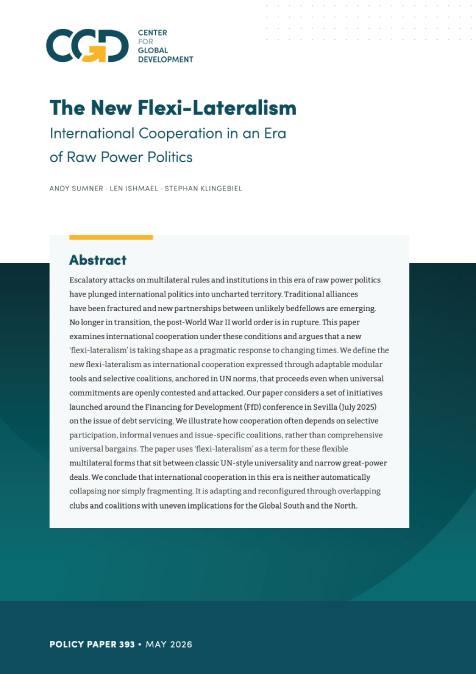
    Climate policy is increasingly reshaping the conditions under which firms participate in international markets. As some jurisdictions introduce carbon border adjustments, lifecycle emissions standards, and supply-chain traceability requirements, market access is starting to be made conditional on verifiable characteristics of production processes, such as carbon intensity, embedded emissions, and input sourcing, rather than solely on product characteristics or prices. This paper exa ...
  • April 27, 2026
    This episode examines firms’ access to finance in Morocco, highlighting its critical role in business creation and growth, especially for SMEs. It challenges common assumptions by showing that medium-sized firms, rather than small ones, face the most binding financial constraints. The d...
  • April 27, 2026
    This episode examines Morocco’s handicraft sector, highlighting its economic importance as a major source of employment and value creation, despite being often overlooked. It presents new empirical evidence showing the sector’s gradual shift toward more formalized SMEs, while exposing i...
  • Authors
    April 6, 2026
    World trade was more resilient than expected during 2025. Its growth probably resulted from the way the rest of the world reacted to the U.S. tariffs. Other factors also had an impact, including moves by exporters to the U.S. in the first half of 2025 to get ahead of the tariffs, and the boom in global tech capital expenditures driven by investment in artificial intelligence (AI).The trade pattern observed in 2025 and early 2026 could point to a new architecture of world trade. Ther ...
  • April 6, 2026
    Trade agreements, in earlier eras, were instruments of exchange. In the present one, they have become instruments of order. The EU–Mercosur agreement, after more than two decades of negotiation, reaches a decisive moment—not merely as a framework for tariff reduction, but as a mechanism through which competing visions of economic organization are projected and contested. ...
  • Authors
    April 1, 2026
    We are now in the fifth week since the U.S. airstrike that killed top leaders of the Iranian regime, initiating a war involving the United States and Israel against the country. More than a month of mutual bombardments between Iran and Israel has ensued, extending to other Persian Gulf nations, U.S. military installations—and even Cyprus. From a global perspective, the impact has stemmed primarily from disruptions to regional production of goods and the blockade of the Strait of Hor ...
  • March 27, 2026
    This interview analyzes how tariff wars are transforming global power dynamics, disrupting trade systems, and redefining trade policy as a geopolitical tool, while examining the risks and opportunities for emerging economies and the Global South, the repositioning of regions like Latin ...
  • Authors
    Jonathan Berkshire Miller
    March 10, 2026
    At the Atlantic Dialogues in December 2025, I argued that a period was underway in which trade and security could no longer be analytically or practically separated. Assessments have solidified in recent months regarding the emergence of a geoeconomic world order. Geoeconomics was a gradual transition from a purely geopolitical focus on military force, to an emphasis on economics to gain competitive advantage. It is no longer a transitional phase, but an emerging structural componen ...
  • Authors
    March 3, 2026
    The February 20 United States Supreme Court decision against President Donald Trump’s use of the U.S. International Emergency Economic Powers Act (IEEPA) to establish tariffs has led him to resort to other legal instruments. So-called U.S. reciprocal tariffs on countries set out in April 2025 were based on IEEPA, as were tariffs that allegedly punished countries for allowing fentanyl into the U.S. Trump tried to evade the constraints presented by other legal instruments that could f ...