Publications /
Policy Brief

Back
Brazil is in dire need of more and better infrastructure investments
Authors
January 31, 2020

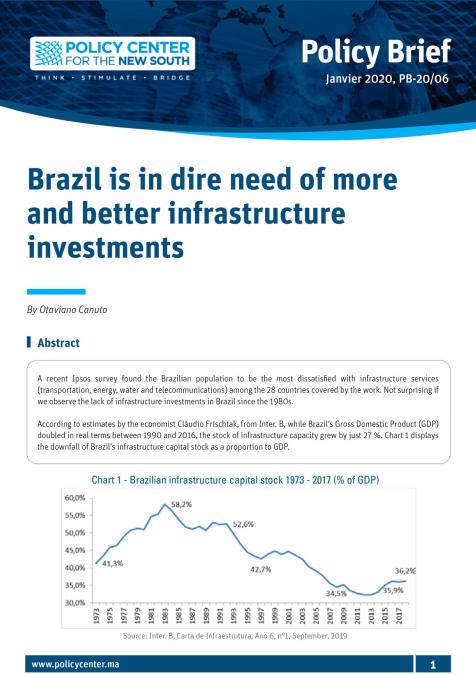
A recent Ipsos survey found the Brazilian population to be the most dissatisfied with infrastructure services (transportation, energy, water and telecommunications) among the 28 countries covered by the work. Not surprising if we observe the lack of infrastructure investments in Brazil since the 1980s. According to estimates by the economist Cláudio Frischtak, from Inter. B, while Brazil's Gross Domestic Product (GDP) doubled in real terms between 1990 and 2016, the stock of infrastructure capacity grew by just 27 %. Chart 1 displays the downfall of Brazil’s infrastructure capital stock as a proportion to GDP.

Figures from World Bank report (Raiser et al, 2017) point to infrastructure investments averaging over 5% of GDP between the 1920s and 1980s, a period in which per capita income grew at an annual rate average of 4% and urbanization reached levels of 60% in 1980. In the last two decades, however, the pace of investment has fallen to less than 2.5% of GDP, even below its maintenance needs (Chart 2, left side).

Brazil’s current inventory of physical infrastructure, relative to GDP, is smaller than most countries with comparable income levels. Although access to electricity and telecommunications has improved since the 1990s, basic sanitation and transportation networks are falling short of those of their peers - even when one considers the country’s relatively high territorial dispersion and low population density.

RELATED CONTENT

  • Authors
    Ana Maria Bonomi Barufi
    Peter Nijkamp
    May 27, 2016
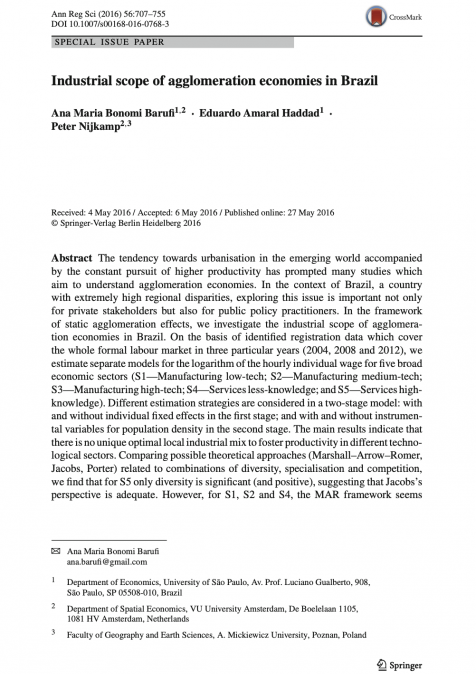
    The tendency towards urbanisation in the emerging world accompanied by the constant pursuit of higher productivity has prompted many studies which aim to understand agglomeration economies. In the context of Brazil, a country with extremely high regional disparities, exploring this issue is important not only for private stakeholders but also for public policy practitioners. In the framework of static agglomeration effects, we investigate the industrial scope of agglomeration econom ...
  • Authors
    Otávio José Guerci SIDONE
    Jesús Pascual MENA-CHALCO
    April 6, 2016
    A recente evolução da ciência brasileira é caracterizada pelo crescimento acelerado da produção científica e pela intensificação da colaboração entre seus pesquisadores. Este trabalho tem por objetivo apresentar elementos sobre o papel da geografia na evolução da produção e colaboração científica no Brasil entre 1992 e 2009, por meio da identificação de padrões espaciais e da importância relativa das regiões em termos de produção, especialização científica e grau de interação colabo ...
  • Authors
    February 10, 2015
    Manufacturing is declining as a share of GDP not only in advanced countries, but in developing countries as well. This new trend, a result of complex forces, should be seen on balance as a reason for development-optimism, not pessimism. In the 21st century economy, manufacturing remains important, but poor countries can attract investment, grow rapidly and diversify away from agriculture on the basis of many possible sources of comparative advantage, without artificially promoting m ...