Publications /
Opinion
The movement of the camels, for days and days under the burning sun, started to tire the traveler; the heat was unbearable, the water bottle empty. Suddenly, the exhausted foreigner saw water, a lake, on the horizon, and a sailing boat, a felucca as the Egyptians use on the Nile. Another mile of suffering on the snorting camels and the body would be cooled by water, crystal clear water. The closer the caravan approached the shores of the lake, the more the spirit of the traveler rejoiced.
Alas, the water was never reached. It was a phenomenon, known as Fata Morgana, or mirage. A visual illusion. In centuries past, it took explorers a year to survive the ride across the mysterious Sahara, many so desperate for water that they tried to survive by drinking camel urine. The Sahara is the largest desert on earth, its dimensions comparable to the United States of America, a vast and empty, arid space, driving some travelers into hallucinations. At night, the stars are a natural symphony of light. Dogons, a nomadic tribe, famed for their astrological knowledge, discovered the star Sirius B more than a thousand years ago.
Nomads, often of the Tuareg, famous for courage and for their blue robes, are able to cross the desert without GPS, trusting their instincts and camels, since losing one’s way could mean death. The word ‘Sahara’ provokes romantic imaginings or fear in people who have never faced the harsh lifestyle. Timbuktu is such mythic place, one of the gateways to the Sahara, within the confines of extended fertile zones . From here, Islam spread throughout Africa. In Timbuktu trade flourished: ivory, gold, animals, ostrich feathers. Salt was imported from the north, cattle and grain traded with the south.
Centuries ago caravans crossed the desert from Mali to a town on the Atlantic coast, Mogador, today known as Essaouira. The camels were loaded with valuable goods for the merchants of Mogador, who were also interested in trading slaves until the end of the nineteenth century (The Caravan routes of Morocco, Lynn Sheppard). The camel drivers directed their camel trains, at times 1000 camels or more, towards oases, green spots in the deserts, which would give them shelter and water. Many oases are surrounded by date palms, some figs are planted, or citrus fruits and a few meager fields, where camels and donkeys and goats could experience their own Fata Morgana—non-existent grass. Foreign adventurers recovering at an oasis might share the shadow of the date palms with an unusual group of warriors, Tuareg tribesmen, also known as pastoralists, a profession demanding resilience and willingness to accept harsh conditions. The Tuaregs keep their livestock at the oasis, waiting until they feel strong enough to cross the sand for another 20, 30 or 100 kilometers, searching for secure grazing.
But as soon as they leave the desert, reality catches up with them. Cattle thieves will hold them up, some ISIS fighters will force them to slaughter a sheep or goat or two, border guards will refuse the herders entry into foreign lands, like Benin, for example. No one knows for certain how many of the larger oases in the Sahara still exist (National Geographic estimated 90), or how many herders still risk crossing the desert with their livestock, which is part of the food security of neighboring Sahel nations including Niger, Chad, Mali, and Burkina Faso.
Huge Areas are Empty
Today the Tuareg inhabit a vast area in the Sahara, stretching from south-western Libya to southern Algeria, Niger, Mali, Burkina Faso, and the far north of Nigeria. Their combined population in these territories exceeds 2.5 million, with an estimated population in Niger of around 2 million and in Mali another 0.5 million. The Sahara (excluding the Nile valley), according to the Encyclopedia Britannica, “is estimated to contain only some 2.5 million inhabitants, less than one person for 0.4 kilometers”. Huge areas are empty, but wherever meager vegetation can support grazing animals or reliable water sources occur, scattered clusters of inhabitants have survived in fragile ecological balance with one of the harshest environments on earth.
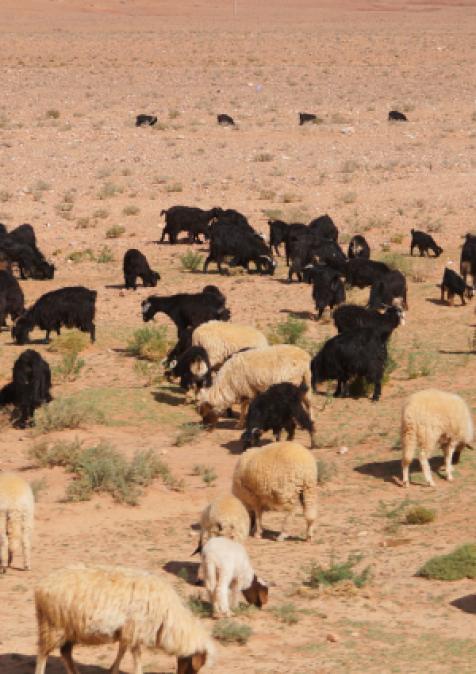
Pastoralism, always nomadic to some degree, occurs when enough pasturage exists, whether in the marginal areas, on the mountain borders, or in the slightly moist west. Cattle appear along the southern borders of the Sahel, but sheep, goats and camels are the mainstay in the desert. “On the regional level”, writes Pierre Jacquemot in his alarming and brilliantly researched Policy Paper, ‘Le pastoralism en péril en Afrique’ (‘Pastoralism in Peril in Africa’), published by the Policy Center for the New South (February, 2023), “pastoralism is an important economic element in African nations, playing an important role in the delivery of animal products for the Saharan markets and the major cities at the Gulf of Guinea”. The system of pastoralism meets 60% to 65% of Kenya’s beef consumption, and 90% of Ethiopia’s milk. Animal breeding and livestock trading represent the third most important export from Mali, after gold and cotton. Niger’s livestock is the second export item after uranium. Jacquemot is certain: “All African herders are facing fundamental transformations because of demographic changes, growing insecurity, environmental upheaval and political incoherence”.
The consequences of these changes may be dramatic. “The system of pastoralism”, says the FAO, quoted by Jacquemot, provides “food for about 268 million people in 36 nations of the continent”. In the Sahel, occupied by 40 million people, 15 million are active in ‘transhumance’ (seasonably mobile) movements, making for the largest nomadic group on earth. In the Sudano-Sahel region—the band of dry land on the southern edge of the Sahara—writes Marion Davies (Stockholm Environmental Institute, January 18, 2022), more than 20 million people support themselves with pastoralism. “Scant and unreliable rainfall and poor soils make the land difficult to farm, so for centuries many people have raised livestock instead, moving their livestock periodically to find fresh pastures and allow the land to recover”. Climate change, the ever-growing threat of drought, and the lack of rain force pastoralists to search for ever-more distant grazing grounds, at times triggering conflict with farmers. Thousands of herders and farmers have died in the last decades in these battles for survival, and no end is in sight. Marion Davies wrote of “certain places where violent conflicts have erupted, linked to more than 15000 deaths since 2010 in West and Central Africa, more than half since 2018”.
Working with Nature
In an extensive report, ‘Pastoralism and Resilience of Food Production in the Face of Climate Change’ (2022), GIZ (Deutsche Gesellschaft fuer Internationale Zusammenarbeit) states: “One half of the global land surface is rangeland, i.e. regions that can be used economically and sustainably for food production only through grazing. Pastoral systems are able to make use of about 70 percent of the range lands, including some of the most extreme environments in form of natural and climate conditions.” Estimates of numbers involved vary from 200 million to 600 million people. In Africa only, reports GIZ, pastoral systems support the livelihoods of about 100 million people. “Relying on pockets of wetter rangeland and farmland to survive during the dry season”confirms the GIZ report, “and in times of droughts, these systems produce substantial economic value, by making use of the vast expanses of rangelands not suited for crop production.”
“In sub-Saharan Africa”, notes GIZ, “despite chronic underinvestment (African Union, 2010) pastoralism’s contribution to agricultural GDP averages 40 percent, often including the bulk of meat for both, domestic markets and exports. As these systems make only negligible use of cereals as feed, and of external inputs based on fossil fuels, they are amongst the most efficient in the world in sustainably producing human edible protein .”(FAO 2021) Giz argues that pastoral systems “benefit from their close integration with their natural environment”, in a way following the mood of nature, sending sheep and cattle and donkeys and camels to pastures touched by rain, grazing forever if needed, abandoning the land fat and rested, cows pregnant, calves born. The climate changes, the herd moves on, looking for water and rest. Resilience to climate variability, concluded giz, is “at the core of pastoralism as a specialist livelihood and production system”. Indeed, while managing uncertainty, “pastoralists have the ability to achieve relative stability of food production from an unpredictable climate: A relatively stable level of production is achieved by working with nature than by separating from it.” (GIZ)